

A REFLECTION ON VENGEANCE, VIOLENCE, NONVIOLENCE & RECONCILIATION
Sunday, April 26, 2015
Tuesday, April 21, 2015
The Failure

•••
There are those who are not really failures in life, but anyway carry failure deep in their hearts; and there are those who are failures, but anyway feel successful down deep inside them. Of course, most successful people feel that they are indeed, well, successful.
We were born in a success oriented world; everything we were taught is about how to be successful. We were taught since our first growing years how to avoid failure. How then, can we start our humble search for truth, when we feel we do not even need it? It never even cross our minds; either we are trying hard to be successful or just too busy with our successes.
•••
I have this inner failure, this inner void;
and I feel trapped in its vast and endless nothingness.
But to get out, I have to admit that I am in here in this great trap.
And to get out, I have to recognize how empty I am inside.
Only then, can I really start with the humble search for inner truth.
•••

Wednesday, October 22, 2014
The Total Revolution

• A revolution that doesn't have the human being as its main focus and concern, and is not totalizing in scope is just another lost opportunity. All these so-called revolutions are merely historical anecdotes, and are just postponing the real one.
• They are good - in and of themselves - but, we cannot believe that they will transform the world.
• It is like donating money or volunteering to feed the hungry, which is a worthy cause. The hungry gets to eat, and people feel good for doing their part. But, it does not, and will not end poverty and hunger in the world.
• I'm not saying that people should stop doing these things, and I'm not saying that these actions are bad; in reality, they are good and worthwhile endeavors. But, in the end, they do not transform anything.
• It is the same with politics. You can support this candidate, or that party - because, they are less evil, or because you like their slogans; but, in the end, the results are the same, and the system is again given a life extension of another thousand years.
• Every time we participate in the games of the system, we postpone the real change, the real transformation. If we play their game, they win - and by extension - we lose.
• So, when will the system fall?
• It will fall and collapse from within - only if and when we stop participating and playing their game.
•••
• What the world needs now are not baby steps, but one big giant leap.
• What the world needs is a totalizing revolution, a revolution that is social, cultural, and psychic. It needs real transformation, not reformation. It means not only external transformation, but also, as important, internal transformation.
• External transformation means a total collapse of the system and its concomitant transformation.
• Internal transformation means that each of us have rid ourselves of our internal frustrations, contradiction, revenge and violence; it means that we are reconciled with our past, and have active nonviolence integrated as our daily mode of action.
• A world transformed means a new civilization where nonviolence and compassion prevails.
•••
Thursday, July 17, 2014
Definition of Violence
•••

What is Violence?
Depending on where in the political spectrum one is, it’s either it’s Hamas or Israel’s fault that the Gaza Strip is once again flaring up. But, it’s clear that the majority of people agree that Israel’s reaction - the target bombing of Gaza - is disproportionate to the rockets from the Hamas.
I’m not going to play the blaming game here, but it seems clear to me that the root of this conflict just cannot be found anymore - it is just too way deep for anyone to see anything. What people are seeing are just the fruits of those thousands of years old conflict in the Middle East.
Definition of Violence
What is really clear to me is that people just do not know the real definition of violence. The headlines say “Death Toll of Children Rise to 34 as Israel Plummets Gaza”. And the whole world is suddenly awake and angry. 34 children dead from an all-out bombing campaign from Israel. This is the wake up call. I’m not saying that Israel should continue this assault on innocents; but at this very moment, there are 85,000 children dying from hunger every single day and no one is angry.
Children killed by bombs is violence, while children dying of hunger is natural? So, therefore it’s not violence?
There are many forms of violence; and these are physical, racial, religious, sexual, psychological, and economic violence. When 34 children are killed from bombing campaigns, this is physical violence. When 85,000 children die of hunger every single day, this is economic violence. When a mother is fearful of the next bomb killing her only child, that’s psychological violence. When a mother is fearful of her child dying from lack of nutrition, that’s psychological violence.
We should condemn Israel for its disproportionate bombing of Gaza; but we should also condemn Hamas from firing rockets to Israel. These are examples of physical violence. But, we should not forget the other forms of violence that are prevalent in the whole world, and in all levels of society.
•••
Sunday, July 14, 2013
El Instinto de Conservación de la Especie Humana
•••

El Instinto de conservación de la especie humana
¿Qué significan todas las manifestaciones, protestas, y sucesos que están ocurriendo en todo el mundo en los últimos 2 años?
La gente que observa pasivamente al margen, o en sus televisores en casa preguntan: ¿qué es lo que quieren todos esos manifestantes? ¿Sobre qué protestan? ¿Realmente saben qué es lo que quieren? Aquí en Brasil, las manifestaciones empezaron cuando los pasajes del bus y el metro subieron 10 centavos, pero incluso después de que los gobiernos locales los bajaron a sus niveles originales, las protestas no amainaron.
Durante las manifestaciones en algunos países en el Medio Oriente, de la “Primavera árabe”, la gente exigía un cambio de régimen. En otras manifestaciones la gente pide mejoras en la educación. En Europa y Chile piden educación, servicios de salud sin costo, etc. En algunas manifestaciones las exigencias de los partícipes son tan diversas como los derechos de los gay, temas ambientales, derechos animales, transparencia en el gobierno, una prensa verdaderamente libre, servicios de salud universales, verdadera democracia, justicia social, etc. Algunos se quejan de los GMO, de funcionarios públicos corruptos, de la brutalidad policíaca, el sistema bancario en quiebre, los regímenes autoritarios, etc.
En algunos países las masas pueden conseguir lo que querían. Pudieron deshacerse de tiranos, dictadores, juntas militares; pudieron lograr el cambio de régimen. Pero ¿por qué siguen protestando? ¿Por qué siguen en las calles, en las plazas y los parques?
¿Qué está sucediendo de verdad?
Lo que sucede es que la gente empieza a sentir un malestar generalizado. De alguna manera se sienten agitados internamente. Solo saben que algo anda mal, que de alguna manera hay algo que no está funcionando.
Los dos instintos primordiales son: el instinto de la autoconservación, y el instinto de la conservación de la especie.
Hemos de comprender que, si nosotros como individuos tenemos una consciencia individual, también debemos entender que la especie como un todo es también una entidad; que la especie como entidad, tiene su propia consciencia. Estén conscientes de que, en este mismo momento, es esa consciencia que opera ahora en esos movimientos. Y es la especia humana como un todo, es esa consciencia humana la que percibe la amenaza que la enfrenta. Y sabe que a sus espaldas yace el gran abismo. Sabe que el sistema ya se encuentra en una situación límite y que está a punto de llevarse todo consigo. Esa consciencia colectiva ha despertado y quiere superar aquel abismo.
Ya no se trata de qué es lo que quiere la gente. Ya no se trata de lo que tú y yo queramos. No se trata de lo que queramos como individuos. Ahora, se trata de lo que la especie como totalidad necesita. Y necesita una respuesta totalizadora a las crisis globales que enfrenta: necesita el cambio total. Necesita transformación. Sabe que para sobrevivir, debe dar un salto gigantesco, hacer la revolución total, la transformación total: del individuo, del sistema, de la especie.
•••
Monday, June 24, 2013
The Instinct of Conservation of the Species -
•••
What does it mean, all these demonstrations, protests, and manifestations that is now happening around the world this past two years?
People watching on the sidelines, or on their televisions at home are asking: what do these demonstrators want? What are they protesting about? Do they really know what they want? Here in Brazil, the manifestations begun with the raising of bus and subway fares by 10 cents; but, even after the city governments lowered the fares back, the protests continue, anyway.
During the "Arab Spring" demonstrations in some countries in the Middle East, people were demanding regime change. In some, the people want better education. In Europe and Chile, they want free education, free health services, etc. In some demonstrations, the participants' demands are diverse as rights of gays, environmental issues, animal rights, government transparency, truly free press; universal health care; real democracy; social justice, etc. Some people complain about, GMOs, corrupt officials, police brutality, the bankrupt banking system, authoritarian regimes, etc.
In some countries, the masses are able to get what they wanted. They were able to get rid of tyrants, dictators, military juntas - they were able to achieved regime change. But, why are they still protesting? Why are they still out on the streets? out in the plazas and squares?
The two main instincts are the instinct of preservation of oneself; and the instinct of the conservation of the Species -
We have to understand that if we as individuals have individual consciousness, we also to understand that the species as a whole is also an entity in itself; that the species as a entity has its very own consciousness. Be aware that at this very moment, it is this consciousness that is now operating in these movements. And it is the human species as a whole, this human consciousness that senses the threat it is presently faced with; and it knows that behind its back lies the great abyss. It knows that the system is already at its limit situation, and that it is about to bring everything to the abyss with it. This collective consciousness has awaken, and it wants to overcome this abyss.
It's not anymore about what people want. It's not anymore about what you and I want. It is not about what we as individuals want. Now, it is about what the species as a whole needs. And it needs a totalizing answer to the global crises at hand; it needs a total change; it needs transformation. It knows that to survive it has to make this giant leap, a totalizing revolution, a total transformation - of the individual, of the system, of the species.
•••
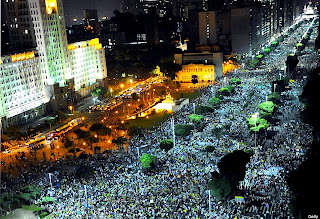
What does it mean, all these demonstrations, protests, and manifestations that is now happening around the world this past two years?
People watching on the sidelines, or on their televisions at home are asking: what do these demonstrators want? What are they protesting about? Do they really know what they want? Here in Brazil, the manifestations begun with the raising of bus and subway fares by 10 cents; but, even after the city governments lowered the fares back, the protests continue, anyway.
During the "Arab Spring" demonstrations in some countries in the Middle East, people were demanding regime change. In some, the people want better education. In Europe and Chile, they want free education, free health services, etc. In some demonstrations, the participants' demands are diverse as rights of gays, environmental issues, animal rights, government transparency, truly free press; universal health care; real democracy; social justice, etc. Some people complain about, GMOs, corrupt officials, police brutality, the bankrupt banking system, authoritarian regimes, etc.
In some countries, the masses are able to get what they wanted. They were able to get rid of tyrants, dictators, military juntas - they were able to achieved regime change. But, why are they still protesting? Why are they still out on the streets? out in the plazas and squares?
The two main instincts are the instinct of preservation of oneself; and the instinct of the conservation of the Species -
We have to understand that if we as individuals have individual consciousness, we also to understand that the species as a whole is also an entity in itself; that the species as a entity has its very own consciousness. Be aware that at this very moment, it is this consciousness that is now operating in these movements. And it is the human species as a whole, this human consciousness that senses the threat it is presently faced with; and it knows that behind its back lies the great abyss. It knows that the system is already at its limit situation, and that it is about to bring everything to the abyss with it. This collective consciousness has awaken, and it wants to overcome this abyss.
It's not anymore about what people want. It's not anymore about what you and I want. It is not about what we as individuals want. Now, it is about what the species as a whole needs. And it needs a totalizing answer to the global crises at hand; it needs a total change; it needs transformation. It knows that to survive it has to make this giant leap, a totalizing revolution, a total transformation - of the individual, of the system, of the species.
•••

Wednesday, June 27, 2012
One's Placement
•••
I had a very nice experience just a few days ago while riding my bus home. I realized that everything in one's past or even in one's present - every thing, every situation, every experience could be changed from negative to positive (or vice-versa) by just changing one's point of view - by just changing one's placement in front of the situation. I realized that in every thing, in every situation, in every experience, comes with it the negative and the positive - so depending on where one place oneself, the experience could be a bad experience or a good experience.
I want to add that, by changing your point of view and your placement towards your past and your present, and thereby, changing them to positive, you are actually also changing your life towards a positive future.
•••
I had a very nice experience just a few days ago while riding my bus home. I realized that everything in one's past or even in one's present - every thing, every situation, every experience could be changed from negative to positive (or vice-versa) by just changing one's point of view - by just changing one's placement in front of the situation. I realized that in every thing, in every situation, in every experience, comes with it the negative and the positive - so depending on where one place oneself, the experience could be a bad experience or a good experience.
I want to add that, by changing your point of view and your placement towards your past and your present, and thereby, changing them to positive, you are actually also changing your life towards a positive future.
•••
Monday, December 15, 2008
BOOK II, First Word
•••
As mentioned earlier, the only way to finish the first book is to end it before it is actually finished. So, we wrapped up the first part of the study and is now starting with the second one. Just to let you know, a friend doing the editing of the book just informed me that the editing will be finished by next week. Another good friend will be writing the Preface, and an old friend will write the Introduction. So, yesterday was really a great day. It is now just a matter of time and the book will be published. Hopefully, it will be available from amazon.com and your favorite bookstore by the summer of next year. Summer in the North Zone, that is; winter here in Rio de Janeiro, the cidade maravilhosa.
Now, on to the next.
Like the entries in the first book, this one will also be written in blog form. It will be a continuation of this blog on vengeance, violence and nonviolence. This time, we will try to analyze vengeance and violence in all its forms -- in all its subtleties. It will be tentatively titled, "Beyond Mere Survival: The Instinct of Nonviolence".
Among other subjects, we will tackle the themes on possession, imposition, laws, war, suffering, sacrifice, criticism, self-criticism, freedom of choice, tolerance, receiving, giving, forgiving, reconciliation, meaning, humility, cultural diversity, individual diversity, "letting go", and for some reason, I would like to include the theme of aesthetics.
•••
•••
As mentioned earlier, the only way to finish the first book is to end it before it is actually finished. So, we wrapped up the first part of the study and is now starting with the second one. Just to let you know, a friend doing the editing of the book just informed me that the editing will be finished by next week. Another good friend will be writing the Preface, and an old friend will write the Introduction. So, yesterday was really a great day. It is now just a matter of time and the book will be published. Hopefully, it will be available from amazon.com and your favorite bookstore by the summer of next year. Summer in the North Zone, that is; winter here in Rio de Janeiro, the cidade maravilhosa.
Now, on to the next.
Like the entries in the first book, this one will also be written in blog form. It will be a continuation of this blog on vengeance, violence and nonviolence. This time, we will try to analyze vengeance and violence in all its forms -- in all its subtleties. It will be tentatively titled, "Beyond Mere Survival: The Instinct of Nonviolence".
Among other subjects, we will tackle the themes on possession, imposition, laws, war, suffering, sacrifice, criticism, self-criticism, freedom of choice, tolerance, receiving, giving, forgiving, reconciliation, meaning, humility, cultural diversity, individual diversity, "letting go", and for some reason, I would like to include the theme of aesthetics.
•••
Note 1: If you want to read Book One of this series, please go to the August Archive, or click here.
Note 2: If you prefer to read Book One offline, please click here to download the manuscript to your computer.
Note 3: If you prefer to read Book One in PDF form, please click here.
Note 4: If you prefer to read the Spanish version in PDF form, please, click here.
•••
Important Notice
•••
Please, take note that since this blog was intended to be published later in book form -- it reads from top to bottom -- instead of the normal blog form, where the latest post is always at the top. In this format, you can find the latest entry at the bottom.
If you like to read Book One, FREE INTERPRETATION REDUX, Please, click here.
Thanks, for following...
Godi
:::::
If you like to read and know more about Silo, please, go to...
http://silo.net
•••
Please, take note that since this blog was intended to be published later in book form -- it reads from top to bottom -- instead of the normal blog form, where the latest post is always at the top. In this format, you can find the latest entry at the bottom.
If you like to read Book One, FREE INTERPRETATION REDUX, Please, click here.
Thanks, for following...
Godi
:::::
If you like to read and know more about Silo, please, go to...
http://silo.net
•••
The Pre-condition
•••
I know I begun the first book with questions and ended it with even more questions; but what can I do? This is how it is -- I just do not know the answers to most of these questions. I am finding out that the more I know, the more I know that I do not know anything. But at the least, this I know for certain: the only way for man to stop violence is for him to stop thinking that his violence is inherent in him -- to stop thinking that it is natural for him to be violent. But this is just the pre-condition. Knowing you're sick does not cure the illness, but anyway, you have to know first that something is wrong before you can make it right. Right?
And how do we make it right?
How else, if not by asking more questions.
•••
I know I begun the first book with questions and ended it with even more questions; but what can I do? This is how it is -- I just do not know the answers to most of these questions. I am finding out that the more I know, the more I know that I do not know anything. But at the least, this I know for certain: the only way for man to stop violence is for him to stop thinking that his violence is inherent in him -- to stop thinking that it is natural for him to be violent. But this is just the pre-condition. Knowing you're sick does not cure the illness, but anyway, you have to know first that something is wrong before you can make it right. Right?
And how do we make it right?
How else, if not by asking more questions.
•••
Possession
•••
• Why talk about possession? How is possession related to violence?
• But first, what is possession? What is it to possess?
• Is to possess the same as to acquire, to own, to have? Does it refer to the actual owning of objects and objects of affection, or does it have to do more with the emotional attachment to the thing or person that we possess? Is it the opposite of "letting go"? It is like saying, to dispossess is to let go. But, let go of what?
• Is controlling, the same as possessing? Is to possess something or someone, the same as to have control over something or someone?
• Why then, do we want to control? Why do we want to possess?
• Is compassion the anti-thesis of possession?
• Does possession have anything to do with the consciousness' inherent need to perpetually balance* itself? Is it trying to be in equilibrium by compensating, by possessing, by owning, by controlling?
• Is to control also to impose?
• Is losing control also losing "balance"?
• Does balance have anything to do with symmetry? with aesthetics?
• It is like we have many worlds, and we need to control these worlds.
•••
*To read more about balance, please, go to the entry in Book I, The Balance.
•••
• Why talk about possession? How is possession related to violence?
• But first, what is possession? What is it to possess?
• Is to possess the same as to acquire, to own, to have? Does it refer to the actual owning of objects and objects of affection, or does it have to do more with the emotional attachment to the thing or person that we possess? Is it the opposite of "letting go"? It is like saying, to dispossess is to let go. But, let go of what?
• Is controlling, the same as possessing? Is to possess something or someone, the same as to have control over something or someone?
• Why then, do we want to control? Why do we want to possess?
• Is compassion the anti-thesis of possession?
• Does possession have anything to do with the consciousness' inherent need to perpetually balance* itself? Is it trying to be in equilibrium by compensating, by possessing, by owning, by controlling?
• Is to control also to impose?
• Is losing control also losing "balance"?
• Does balance have anything to do with symmetry? with aesthetics?
• It is like we have many worlds, and we need to control these worlds.
•••
*To read more about balance, please, go to the entry in Book I, The Balance.
•••
Possession, Part Two
•••
Continuing with the theme of possession...
• Do I exist because of the "objects" around me? Are these "objects" there to give me support?
• Do my identity, my integrity depend on these "objects"? Do I exist because they exists?
What does my identification with these objects got to do with my existence?
• And if they do not exist; where will I be?
• Why are we so very much identified with these "objects"?
• And what are these "objects"? These are things we have, want to have, or things we are afraid to lose. These could be actual objects, like our cars, houses, knick-knacks, pimples, etc.; or intangible things such as ideas, doctrines, causes, opinions, place in society, etc.; or people like, friends, children, love ones, relatives, family, wives, husbands, boyfriends, girlfriends, enemies, etc.
• Yes, enemies. Sometimes, people do need to have enemies, they have to have someone to fight with, to be angry with, to compete with. Films, dramas, need to have villains so that the actions of the hero will have meaning. Is it this same as in real life? Do we really have to have an adversary to give meaning to our lives?
• Even the existing economic system, so called "laissez-faire" is based on competition -- unless of course, the companies of their friends are in danger of collapsing -- then, they start to talk about financial aids and bail-outs.
• And because of this -- because, my existence depends on these "objects" -- is this the reason why it is very hard to let go? Is this the reason why it is not so easy to dispossess?
• And when I lose these objects that I possess, these things that I "own", I suffer. Is it because the balance, the equilibrium is somehow lost when the object is lost -- putting the whole structure out of balance, the whole structure out of equilibrium?
• Or, could it be that this disequilibrium cannot be offset with compensating possession? That when I am able to compensate this disequilibrium by possessing, I am really just getting a temporary reprieve, a temporary balance, an illusory equilibrium?
• And what exactly do we mean when we say that this equilibrium is illusory?
We will discuss this on later blogs.
•••
Continuing with the theme of possession...
• Do I exist because of the "objects" around me? Are these "objects" there to give me support?
• Do my identity, my integrity depend on these "objects"? Do I exist because they exists?
What does my identification with these objects got to do with my existence?
• And if they do not exist; where will I be?
• Why are we so very much identified with these "objects"?
• And what are these "objects"? These are things we have, want to have, or things we are afraid to lose. These could be actual objects, like our cars, houses, knick-knacks, pimples, etc.; or intangible things such as ideas, doctrines, causes, opinions, place in society, etc.; or people like, friends, children, love ones, relatives, family, wives, husbands, boyfriends, girlfriends, enemies, etc.
• Yes, enemies. Sometimes, people do need to have enemies, they have to have someone to fight with, to be angry with, to compete with. Films, dramas, need to have villains so that the actions of the hero will have meaning. Is it this same as in real life? Do we really have to have an adversary to give meaning to our lives?
• Even the existing economic system, so called "laissez-faire" is based on competition -- unless of course, the companies of their friends are in danger of collapsing -- then, they start to talk about financial aids and bail-outs.
• And because of this -- because, my existence depends on these "objects" -- is this the reason why it is very hard to let go? Is this the reason why it is not so easy to dispossess?
• And when I lose these objects that I possess, these things that I "own", I suffer. Is it because the balance, the equilibrium is somehow lost when the object is lost -- putting the whole structure out of balance, the whole structure out of equilibrium?
• Or, could it be that this disequilibrium cannot be offset with compensating possession? That when I am able to compensate this disequilibrium by possessing, I am really just getting a temporary reprieve, a temporary balance, an illusory equilibrium?
• And what exactly do we mean when we say that this equilibrium is illusory?
We will discuss this on later blogs.
•••
Real Estate, Is it Real?
•••
We received a feedback from one of our friends following this blog. They asked, "So what's wrong with my owning a car -- I use it to go to work. And what's so wrong with having my own house?
Of course, there's nothing wrong with owning a car -- to go to work or to go on a holiday. Surely, there's nothing wrong for people to have their own homes. In fact, we believe that every one should have their own homes.
You can own a car, a house, a giant 72-inch LCD High Definition TV, a 200-foot luxury yacht, etc. You can even have your cake and eat it too -- if you can.
But that is not the problem. The problem is not our having, owning or possessing. The problem is our identification -- our emotional attachment, our psychological dependence on these objects. The problem is that we have given these objects attributes that are not present, attributes that they do not have, we have given them false attributes. Sometimes we are still almost like the superstitious caveman believing in the power of his talisman -- although in a more subtle way.
We are so identified with our possessions, we believe they are part of us. If they are damaged or lost, we suffer. Remember the time when your favorite toy got broken? Or the time when your first love broke up with you?
•••
We received a feedback from one of our friends following this blog. They asked, "So what's wrong with my owning a car -- I use it to go to work. And what's so wrong with having my own house?
Of course, there's nothing wrong with owning a car -- to go to work or to go on a holiday. Surely, there's nothing wrong for people to have their own homes. In fact, we believe that every one should have their own homes.
You can own a car, a house, a giant 72-inch LCD High Definition TV, a 200-foot luxury yacht, etc. You can even have your cake and eat it too -- if you can.
But that is not the problem. The problem is not our having, owning or possessing. The problem is our identification -- our emotional attachment, our psychological dependence on these objects. The problem is that we have given these objects attributes that are not present, attributes that they do not have, we have given them false attributes. Sometimes we are still almost like the superstitious caveman believing in the power of his talisman -- although in a more subtle way.
We are so identified with our possessions, we believe they are part of us. If they are damaged or lost, we suffer. Remember the time when your favorite toy got broken? Or the time when your first love broke up with you?
•••
Non-tolerance of Violence
•••
I was just reading a news article regarding the conviction of four members of the Animal Liberation Front getting a maximum of 14 years in prison for a six-year campaign of blackmail against an animal research laboratory in the UK. Although, we condemn extremist activities, no matter for what cause or issue; we think that this sentence is too harsh.
On the other hand, I just cannot understand how some people upon witnessing an animal being abused - say, a dog being beaten by its owner - will do something instantly to stop the owner from continuing his violent act, even to the extent of calling the police phone number, 911, which, by the way, should only be called during emergency – but, will not do anything to stop their government from going to war and killing hundreds of thousands of innocents.
War is the worst kind of violence that could be inflicted on innocent people of the world -- no matter where they are, whoever they may be.
Here is a good example of what we said in an earlier post, that tolerance of violence is violence.
We will add something to this. If tolerance of violence is violence, therefore, non-tolerance of violence is nonviolence.
Working for cessation of wars is active nonviolence.
Wouldn't it be just great if people have the same abhorrence and repugnance to wars and to violence inflicted on their fellow human beings as they have to animal abuse?
•••
I was just reading a news article regarding the conviction of four members of the Animal Liberation Front getting a maximum of 14 years in prison for a six-year campaign of blackmail against an animal research laboratory in the UK. Although, we condemn extremist activities, no matter for what cause or issue; we think that this sentence is too harsh.
On the other hand, I just cannot understand how some people upon witnessing an animal being abused - say, a dog being beaten by its owner - will do something instantly to stop the owner from continuing his violent act, even to the extent of calling the police phone number, 911, which, by the way, should only be called during emergency – but, will not do anything to stop their government from going to war and killing hundreds of thousands of innocents.
War is the worst kind of violence that could be inflicted on innocent people of the world -- no matter where they are, whoever they may be.
Here is a good example of what we said in an earlier post, that tolerance of violence is violence.
We will add something to this. If tolerance of violence is violence, therefore, non-tolerance of violence is nonviolence.
Working for cessation of wars is active nonviolence.
Wouldn't it be just great if people have the same abhorrence and repugnance to wars and to violence inflicted on their fellow human beings as they have to animal abuse?
•••
Judgment Day
•••
I am deleting this entry from Book I and will post it here in Book II instead. It seems to me that the subject is a step closer to the core of the theme of vengeance and violence.
People are so concerned with justice and its application -- they are so obsessed with it, they even invented a god that is ALL-JUST. Why? If not to punish -- and get my vengeance in the afterlife -- people that have done me or other people harm. If I am not able to have my revenge in this life, with a god that is all-just, I am assured that those people will get what they deserved in the afterlife.
In short, people would rather avoid reconciliation and just ignore the principle of solidarity, that says, "Treat others as you want them to treat you" and just go with the principle of "justice" -- which is really masked revenge -- that says, "Treat others as they deserved to be treated".

So, they came up with the concept of the final justice, the ultimate justice, or the ultimate application of justice -- "Judgement Day"! Where, on the "end of days", all sinners who will eventually go to eternal hell will be on god's left, and those on the right will go to heaven (I am not so sure who are the people that will stay on god's right since everyone sinned anyway -- based on their own criteria, anyway).
But, can you see the deep rooted mechanism working here? How a whole culture's psyche is so obsessed with vengeance and revenge? So much so, that they would not only pursue perpetrators to the ends of the earth, but also to the ends of life, and even the afterlife!
•••
I am deleting this entry from Book I and will post it here in Book II instead. It seems to me that the subject is a step closer to the core of the theme of vengeance and violence.
People are so concerned with justice and its application -- they are so obsessed with it, they even invented a god that is ALL-JUST. Why? If not to punish -- and get my vengeance in the afterlife -- people that have done me or other people harm. If I am not able to have my revenge in this life, with a god that is all-just, I am assured that those people will get what they deserved in the afterlife.
In short, people would rather avoid reconciliation and just ignore the principle of solidarity, that says, "Treat others as you want them to treat you" and just go with the principle of "justice" -- which is really masked revenge -- that says, "Treat others as they deserved to be treated".

So, they came up with the concept of the final justice, the ultimate justice, or the ultimate application of justice -- "Judgement Day"! Where, on the "end of days", all sinners who will eventually go to eternal hell will be on god's left, and those on the right will go to heaven (I am not so sure who are the people that will stay on god's right since everyone sinned anyway -- based on their own criteria, anyway).
But, can you see the deep rooted mechanism working here? How a whole culture's psyche is so obsessed with vengeance and revenge? So much so, that they would not only pursue perpetrators to the ends of the earth, but also to the ends of life, and even the afterlife!
In Christian eschatology, the Last Judgment, Final Judgment, Judgment Day, or Day of the Lords is the judgment by God of all nations.[1] It will take place after the resurrection of the dead and the Second Coming (Revelation 20:12–15). This belief has inspired numerous artistic depictions.
The concept of a Last Judgement[2] is also found in all Abrahamic religions and elsewhere (for example, see Duat).
There is little agreement among Christian denominations as to what happens after death and before the Last Judgment.
In Islam, the Last Judgment is called a number of things, including yaum al-Qiyamah (literally "the Day of Standing") and God Almighty, or Allah in Arabic, will judge all Creation. --http://en.wikipedia.org/wiki/Last_Judgement
•••
Child Play
•••
Barely two weeks ago, a boy of nine years was tried for the double murder of his father and his father's friend. He was tried as an adult and voluntarily pleaded guilty to avoid harsher punishment.
http://abcnews.go.com/Video/playerIndex?id=6920449
Yesterday, in the news, a boy was charged with the killing of his father's pregnant girlfriend. He too, will be tried as an adult.
These stories are becoming frequent and I am going to put a little twist on this issue. I am not going to invoke the usual anti-gun rhetoric – which would be nice to do, or will I sing the "children are now becoming more violent" song, either. I will still continue to look at it from the vengeance angle.
Trying children as adults are becoming a norm. And why do I think is that? It seems to me that trying our children as adults is really just another means for society to avoid responsibility for its children. If we are not responsible, then, we can never be guilty. If we are not guilty, then, we will avoid the "punishment" here and in the afterlife -- as a consequence of that failure. Especially, if the child is found guilty, then we are not guilty. Our hands are totally washed, totally sanitized, totally clean. We are completely absolved from the crime and the responsibility of bringing up the child in a nonviolent world. Therefore, we avoid the consequence of punishment in that final judgment we talked about in the previous entry -- not to mention that we also avoid that nasty feeling we call guilt, which we said in another entry is actually self-punishment.
I am slowly realizing that indeed, everything in this culture is, and does revolve around vengeance. How to get vengeance and/or how to avoid vengeance.
This time, it is all about avoiding guilt, avoiding punishment, which is the same as avoiding vengeance.
•••
This issue is related to the discrimination against the young as one of the main form of violence. I believe that no one should be tried and/or sentenced under laws that they did not choose or vote for. If someone is not qualified to vote -- because of mental incapacity or age, then they cannot be tried under laws they are not able to vote for.
•••
•••
Barely two weeks ago, a boy of nine years was tried for the double murder of his father and his father's friend. He was tried as an adult and voluntarily pleaded guilty to avoid harsher punishment.
http://abcnews.go.com/Video/playerIndex?id=6920449
Yesterday, in the news, a boy was charged with the killing of his father's pregnant girlfriend. He too, will be tried as an adult.
These stories are becoming frequent and I am going to put a little twist on this issue. I am not going to invoke the usual anti-gun rhetoric – which would be nice to do, or will I sing the "children are now becoming more violent" song, either. I will still continue to look at it from the vengeance angle.
Trying children as adults are becoming a norm. And why do I think is that? It seems to me that trying our children as adults is really just another means for society to avoid responsibility for its children. If we are not responsible, then, we can never be guilty. If we are not guilty, then, we will avoid the "punishment" here and in the afterlife -- as a consequence of that failure. Especially, if the child is found guilty, then we are not guilty. Our hands are totally washed, totally sanitized, totally clean. We are completely absolved from the crime and the responsibility of bringing up the child in a nonviolent world. Therefore, we avoid the consequence of punishment in that final judgment we talked about in the previous entry -- not to mention that we also avoid that nasty feeling we call guilt, which we said in another entry is actually self-punishment.
I am slowly realizing that indeed, everything in this culture is, and does revolve around vengeance. How to get vengeance and/or how to avoid vengeance.
This time, it is all about avoiding guilt, avoiding punishment, which is the same as avoiding vengeance.
•••
This issue is related to the discrimination against the young as one of the main form of violence. I believe that no one should be tried and/or sentenced under laws that they did not choose or vote for. If someone is not qualified to vote -- because of mental incapacity or age, then they cannot be tried under laws they are not able to vote for.
•••
"Leaders will also have to take positions regarding youth, increasingly characterized as constituting a “threat to society,” with dangerous tendencies toward drugs, violence, and lack of communication. Those leaders who persist in ignoring the profound roots of these problems will be in no position to give satisfactory answers simply by inviting young people to participate in conventional politics or the traditional cults, or to enjoy the offerings of a decadent civilization controlled by money. Meanwhile, such leaders are contributing to the psychic destruction of an entire generation and the rise of despicable new economic powers that grow rich by preying on the anguish and psychological alienation of millions of human beings.
Many leaders now ask in surprise where this growing violence among young people is coming from—as if it were not these leaders themselves, the former or current generations to hold power, who have overseen the perfecting of a systematic violence, exploiting even the advances in science and technology to make their manipulations ever more efficient. —Silo
•••
Intolerance
•••
Do you notice that society is becoming less tolerant? That punishments and penalties are becoming harsher and more stringent? In the US, some States have adopted the so-called "Three Strikes and you're out!" law. When a convicted felon -- who has been punished and has served time in prison -- is charged with a third felony crime -- no matter how minor this third crime is -- like say, stealing a slice of pepperoni pizza from a group of children, on the third sentencing, he is going to get 25 years to life in prison.
When a society is intolerant, doesn't that mean that it has already lost patience with people who are not following the norm?
This intolerance is not just in the justice and criminal systems. But it is also prevalent in the private sector. It is also, being applied in the education, sports and all other sectors of society. In most K-12 schools in the US, the "one strike and you're out" rule are now becoming the norm.
Society are now more concern and give importance to rules, more than to human concerns. Forgetting totally, that these rules were supposedly formulated to benefit the human being. Take for example, that high school student who was barred from attending his graduation ball party right there at the ball entrance, because he was dressed as a girl. This was his only chance to be part of this very important and traditional event -- to be happy and to enjoy the great occasion with his friends, but instead, he is forever scarred from this experience. This young boy IS that human being.
Why is it that a young black man caught stealing a pack cigarettes and some bottles of beer for his third felony conviction can get a life sentence, while a financial magnate who run away with 50 billion dollars -- some of these from pension funds of old people are not even brought to court to face charges?
•••
•••
Do you notice that society is becoming less tolerant? That punishments and penalties are becoming harsher and more stringent? In the US, some States have adopted the so-called "Three Strikes and you're out!" law. When a convicted felon -- who has been punished and has served time in prison -- is charged with a third felony crime -- no matter how minor this third crime is -- like say, stealing a slice of pepperoni pizza from a group of children, on the third sentencing, he is going to get 25 years to life in prison.
When a society is intolerant, doesn't that mean that it has already lost patience with people who are not following the norm?
This intolerance is not just in the justice and criminal systems. But it is also prevalent in the private sector. It is also, being applied in the education, sports and all other sectors of society. In most K-12 schools in the US, the "one strike and you're out" rule are now becoming the norm.
Society are now more concern and give importance to rules, more than to human concerns. Forgetting totally, that these rules were supposedly formulated to benefit the human being. Take for example, that high school student who was barred from attending his graduation ball party right there at the ball entrance, because he was dressed as a girl. This was his only chance to be part of this very important and traditional event -- to be happy and to enjoy the great occasion with his friends, but instead, he is forever scarred from this experience. This young boy IS that human being.
Why is it that a young black man caught stealing a pack cigarettes and some bottles of beer for his third felony conviction can get a life sentence, while a financial magnate who run away with 50 billion dollars -- some of these from pension funds of old people are not even brought to court to face charges?
•••
Notes
Some unusual scenarios have arisen, particularly in California — the state punishes shoplifting and similar crimes involving over $500 in property as felony petty theft if the person who committed the crime has a prior conviction for any form of theft, including robbery or burglary. As a result, some defendants have been given sentences of 25 years to life in prison for such crimes as shoplifting golf clubs (Gary Ewing, previous strikes for burglary and robbery with a knife), nine videotapes (Leandro Andrade, received double sentence of 25 year-to-life for 2 counts of shoplifting), or, along with a violent assault, a slice of pepperoni pizza from a group of children (Jerry Dewayne Williams, four previous non-violent felonies, sentence later reduced to six years).
In one particularly notorious case, Kevin Weber was sentenced to 26 years to life for the crime of stealing four chocolate chip cookies (previous strikes of burglary and assault with a deadly weapon).[9] --
http://en.wikipedia.org/wiki/Three_strikes_law
•••
Sinopse
•••
I just got this Portuguese translation from Sabine, our friend here in Rio de Janeiro. This is the synopsis from Book One. I am including it here for our Portuguese speaking friends.
•••
• No início deste blog, explicamos que nosso interesse ao criá-lo era começar um estudo e uma busca pela raiz da vingança e da violência no contexto da cultura ocidental. Porém, desde o princípio, eu já intuia que o escopo de pesquisa e estudo para o tema teria de, necessariamente, englobar a ampla gama de elementos que não estão relacionados somente ao tema da vingança e da violência, mas requerem também um mergulho no tema da não violência. E se quiséssemos ir mais fundo no estudo da vingança e da violência, seria fundamental falar também sobre o compreender e reconciliar com os demais. Também estava claro que o estudo dentro do contexto da Cultura Ocidental não seria suficiente: a Cultura Oriental teria que ser parte disso, necessariamente.
• Então, começamos propondo questões em relação à vingança e à violência. Em seguida, propusemos mais questões. Mais tarde, propusemos ainda mais perguntas. Ficou claro para mim que estou escrevendo esse blog porque eu quero encontrar por mim mesmo as respostas para essas perguntas. E que, talvez, através de tal pesquisa e estudo, eu possa esbarrar em algumas das respostas. Ou poderia estar esperando que as respostas se apresentassem enquanto seguimos esta trilha.
• As perguntas fundamentais, dessa forma, eram o que as palavras vingança e violência significavam e se esses estados eram intrinsecos ao ser humano.
• Dissemos que a vingança não é um fenômeno mecânico de ação-reação. Dissemos que, na verdade, é a base de toda violência. Que a vingança é o ato de equilíbrio diante de um desequilíbrio dado: o equilíbrio do desequilíbrio. Dissemos que o ato de vingança está sempre presente, ainda que sutilmente, sempre trabalhando no pano de fundo. Está sempre presente no trabalho de uma estrutura ato-objeto tentando compensar a inadequação de cada um, o que falta, o que teme, suas frustrações; tentando compensar o núcleo de devaneios de cada um - seu núcleo cultural.
• Fica claro que essa interpreação da vingança poderia parecer um tanto radical para o leitor, mas terei que deixá-la assim.
• Depois, apresentamos outra idéia não tão usual: a noção de que a violência nunca é pessoal. Dissemos que, mais frequentemente do que imaginamos, nossa raiva está direcionada às pessoas mais próximas a nós e que as razões não têm nada a ver com aquilo que nossos seres queridos fizeram ou deixaram de fazer conosco, mas que, ao invés disso, tinham mais a ver com nossas próprias frustrações - aquelas experiências negativas que se acumularam em nós. Estamos somente esperando uma justificativa para soltar nossa raiva, a violência que temos dentro de nós.
• Acontece o mesmo com líderes governamentais: eles precisam de uma razão, uma justificativa para ir a guerra. Eles sempre precisam de uma razão para expressar sua violência interna - expressar sua violência em outros, em sua maioria, pessoas inocentes.
• Depois, falamos sobre a base da maioria das leis, especialmente no Ocidente. Existe um edito muito antigo e arcaico do Código Hammurabi que diz "olho por olho". Dissemos que isso foi formulado para fazer com que as pessoas parassem com punições desproporcionadas. Dissemos que foi um bom conceito em seu momento. Porém, também dissemos que atualizações melhoradas e mais avançadas deste velho conceito foram lançadas ao longo dos séculos por diferentes mensageiros e pessoas iluminadas.
• Propusemos que quando a integridade de um indivíduo, um povo, ou mesmo uma cultura inteira, é ameaçada, uma espécie de sinal de alerta é registrado pela estrutura ameaçada - uma espécie de desequilíbro é registrada - e, instintivamente, uma reação (reequilíbrio) é posta em marcha ( dar o troco, vingança, justiça, ir a guerra, etc)
• Alguns dos leitores do blog nos perguntaram sobre a definição de não violência e dissemos que se o ser humano é intencionalidade e a violência é ir contra a intencionalidade, então, contribuir para o aperfeiçoamento de tal intencionalidade é não violência. Em outras palavras, se sua transformação está prejudicada pelo sofrimento e seu projeto básico é a superação desta dor, deste sofrimento - então, ajudar alguém a aliviar sua dor, seu sofrimento é o maior ato de não violência que uma pessoa pode fazer pela outra - a mais válida de todas as ações! É um projeto de vida por excelência! Resumindo, humanizar a Terra é agir de maneira não violenta. Humanizar é dar em atos unitivos.
• Falamos sobre a ética da reciprocidade e, em seguida, enumeramos algumas passagens famosas do texto de várias crenças religiosas e seculares. Tais crenças foram expressadas de diferentes maneiras, mas basicamente, dizendo o mesmo, que é: trata aos demais como gostaríamos de ser tratados".
• Nós teorizamos que o Ocidente estava interessado em promover justiça para o resto do mundo e que o não-ocidental (o Oriente) estava mais interessado em divulgar o conceito de ahimsa ou não violência.
• Nós falamos, então, sobre livre interpretação. Nós dissemos que a livre interpretação, basicamente, significa que cada um tem direito de interpretar qualquer e todas as coisas de acordo com a experiência de cada um, de acordo com o nível de compreensão de cada um, a cultura de cada um, a história pessoal de cada um. A "verdade" de cada um é uma interpretação. Nesse sentido, do ponto de vista desse conceito de livre interpretação, ou compreendo a ação do outro ou, minimamente, estou entendendo a ação do outro. Porque, a partir deste ponto de vista, nenhuma interpretação está errada - apenas diferente. Eu não estou dizendo que nós toleremos ou aceitemos a violência deles. Estou dizendo que é melhor que nós compreendamos a ação deles, porque ao fazermos isso, diminuimos nosso sofrimento.
• Alguém me pediu para elaborar acerca de um sentimento desagradável chamado culpa. Nós dissemos que toda vez que a consciência recebe um estímulo externo que a coloca em desequilíbrio, a tendência natural da consciência é reagir e tentar conseguir de volta sua integridade "perdida" colocando-se de novo em equilíbrio. Ela tem que "dar o troco" (vingança) no que no momento está em dívida. Porém, a reação é, normalmente, uma reação exagerada (ou é percebida como reação exagerada) e, por conta disso, uma contra ação ainda maior é recebida em troca ou, caso não haja nenhuma, registramos o sentimento de culpa, porque ele satisfaz o vácuo criado pela ausência de uma contra ação. Em outras palavras, sentir-se culpado, de alguma maneira, dá à consciência a ilusão de equilíbrio. É um sentimento similar à auto punição. Portanto, se não recebermos a esperada "vingança", criamos a "reparação" nós mesmos nos sentindo culpados.
• Nós também falamos sobre o conceito de um deus "inteiramente justo" - sobre como a psique de toda uma cultura está tão obcecada com vingança e reparação que eles não somente perseguiriam os infratores até os confins da terra, mas também até o fim da vida e até mesmo no pós vida! O problema com essa noção é que ela dá as pessoas a justificativa para seguirem com sua vingança própria em relação a outros com o pano de fundo na consciência de que estão somente fazendo o trabalho de deus. E também dissemos que tal obssessão com a justiça e a vingança tem raízes tão profundas na cultura Ocidental que é, na verdade, quase um mecanismo.
• Posteriormente, nós aprofundamos nosso desenvolvimento da definição de não violência. Dissemos que não violência não é somente ir contra os horrores da guerra, não é somente estar contra todas as formas de discriminação, não é somente ir contra todas as formas de violência. Está mais relacionada a trabalhar a favor da paz e fazer algo pela paz. Está mais relacionada a trazer a paz dentro de si mesmo e levar a paz a outros. Está mais relacionada a se reconciliar consigo mesmo e se reconciliar com outros. É sentir o humano em você e sentir o humano em outros. É humanizar a si mesmo. É humanizar o outro. É por esta razão que preferimos não chamá-la somente de não violência, mas de não violência ativa.
• Finalmente, dissemos que a não violência está relacionada a liberar-se quando você trata aos demais como gostaria de ser tratado.
•••
I just got this Portuguese translation from Sabine, our friend here in Rio de Janeiro. This is the synopsis from Book One. I am including it here for our Portuguese speaking friends.
•••
• No início deste blog, explicamos que nosso interesse ao criá-lo era começar um estudo e uma busca pela raiz da vingança e da violência no contexto da cultura ocidental. Porém, desde o princípio, eu já intuia que o escopo de pesquisa e estudo para o tema teria de, necessariamente, englobar a ampla gama de elementos que não estão relacionados somente ao tema da vingança e da violência, mas requerem também um mergulho no tema da não violência. E se quiséssemos ir mais fundo no estudo da vingança e da violência, seria fundamental falar também sobre o compreender e reconciliar com os demais. Também estava claro que o estudo dentro do contexto da Cultura Ocidental não seria suficiente: a Cultura Oriental teria que ser parte disso, necessariamente.
• Então, começamos propondo questões em relação à vingança e à violência. Em seguida, propusemos mais questões. Mais tarde, propusemos ainda mais perguntas. Ficou claro para mim que estou escrevendo esse blog porque eu quero encontrar por mim mesmo as respostas para essas perguntas. E que, talvez, através de tal pesquisa e estudo, eu possa esbarrar em algumas das respostas. Ou poderia estar esperando que as respostas se apresentassem enquanto seguimos esta trilha.
• As perguntas fundamentais, dessa forma, eram o que as palavras vingança e violência significavam e se esses estados eram intrinsecos ao ser humano.
• Dissemos que a vingança não é um fenômeno mecânico de ação-reação. Dissemos que, na verdade, é a base de toda violência. Que a vingança é o ato de equilíbrio diante de um desequilíbrio dado: o equilíbrio do desequilíbrio. Dissemos que o ato de vingança está sempre presente, ainda que sutilmente, sempre trabalhando no pano de fundo. Está sempre presente no trabalho de uma estrutura ato-objeto tentando compensar a inadequação de cada um, o que falta, o que teme, suas frustrações; tentando compensar o núcleo de devaneios de cada um - seu núcleo cultural.
• Fica claro que essa interpreação da vingança poderia parecer um tanto radical para o leitor, mas terei que deixá-la assim.
• Depois, apresentamos outra idéia não tão usual: a noção de que a violência nunca é pessoal. Dissemos que, mais frequentemente do que imaginamos, nossa raiva está direcionada às pessoas mais próximas a nós e que as razões não têm nada a ver com aquilo que nossos seres queridos fizeram ou deixaram de fazer conosco, mas que, ao invés disso, tinham mais a ver com nossas próprias frustrações - aquelas experiências negativas que se acumularam em nós. Estamos somente esperando uma justificativa para soltar nossa raiva, a violência que temos dentro de nós.
• Acontece o mesmo com líderes governamentais: eles precisam de uma razão, uma justificativa para ir a guerra. Eles sempre precisam de uma razão para expressar sua violência interna - expressar sua violência em outros, em sua maioria, pessoas inocentes.
• Depois, falamos sobre a base da maioria das leis, especialmente no Ocidente. Existe um edito muito antigo e arcaico do Código Hammurabi que diz "olho por olho". Dissemos que isso foi formulado para fazer com que as pessoas parassem com punições desproporcionadas. Dissemos que foi um bom conceito em seu momento. Porém, também dissemos que atualizações melhoradas e mais avançadas deste velho conceito foram lançadas ao longo dos séculos por diferentes mensageiros e pessoas iluminadas.
• Propusemos que quando a integridade de um indivíduo, um povo, ou mesmo uma cultura inteira, é ameaçada, uma espécie de sinal de alerta é registrado pela estrutura ameaçada - uma espécie de desequilíbro é registrada - e, instintivamente, uma reação (reequilíbrio) é posta em marcha ( dar o troco, vingança, justiça, ir a guerra, etc)
• Alguns dos leitores do blog nos perguntaram sobre a definição de não violência e dissemos que se o ser humano é intencionalidade e a violência é ir contra a intencionalidade, então, contribuir para o aperfeiçoamento de tal intencionalidade é não violência. Em outras palavras, se sua transformação está prejudicada pelo sofrimento e seu projeto básico é a superação desta dor, deste sofrimento - então, ajudar alguém a aliviar sua dor, seu sofrimento é o maior ato de não violência que uma pessoa pode fazer pela outra - a mais válida de todas as ações! É um projeto de vida por excelência! Resumindo, humanizar a Terra é agir de maneira não violenta. Humanizar é dar em atos unitivos.
• Falamos sobre a ética da reciprocidade e, em seguida, enumeramos algumas passagens famosas do texto de várias crenças religiosas e seculares. Tais crenças foram expressadas de diferentes maneiras, mas basicamente, dizendo o mesmo, que é: trata aos demais como gostaríamos de ser tratados".
• Nós teorizamos que o Ocidente estava interessado em promover justiça para o resto do mundo e que o não-ocidental (o Oriente) estava mais interessado em divulgar o conceito de ahimsa ou não violência.
• Nós falamos, então, sobre livre interpretação. Nós dissemos que a livre interpretação, basicamente, significa que cada um tem direito de interpretar qualquer e todas as coisas de acordo com a experiência de cada um, de acordo com o nível de compreensão de cada um, a cultura de cada um, a história pessoal de cada um. A "verdade" de cada um é uma interpretação. Nesse sentido, do ponto de vista desse conceito de livre interpretação, ou compreendo a ação do outro ou, minimamente, estou entendendo a ação do outro. Porque, a partir deste ponto de vista, nenhuma interpretação está errada - apenas diferente. Eu não estou dizendo que nós toleremos ou aceitemos a violência deles. Estou dizendo que é melhor que nós compreendamos a ação deles, porque ao fazermos isso, diminuimos nosso sofrimento.
• Alguém me pediu para elaborar acerca de um sentimento desagradável chamado culpa. Nós dissemos que toda vez que a consciência recebe um estímulo externo que a coloca em desequilíbrio, a tendência natural da consciência é reagir e tentar conseguir de volta sua integridade "perdida" colocando-se de novo em equilíbrio. Ela tem que "dar o troco" (vingança) no que no momento está em dívida. Porém, a reação é, normalmente, uma reação exagerada (ou é percebida como reação exagerada) e, por conta disso, uma contra ação ainda maior é recebida em troca ou, caso não haja nenhuma, registramos o sentimento de culpa, porque ele satisfaz o vácuo criado pela ausência de uma contra ação. Em outras palavras, sentir-se culpado, de alguma maneira, dá à consciência a ilusão de equilíbrio. É um sentimento similar à auto punição. Portanto, se não recebermos a esperada "vingança", criamos a "reparação" nós mesmos nos sentindo culpados.
• Nós também falamos sobre o conceito de um deus "inteiramente justo" - sobre como a psique de toda uma cultura está tão obcecada com vingança e reparação que eles não somente perseguiriam os infratores até os confins da terra, mas também até o fim da vida e até mesmo no pós vida! O problema com essa noção é que ela dá as pessoas a justificativa para seguirem com sua vingança própria em relação a outros com o pano de fundo na consciência de que estão somente fazendo o trabalho de deus. E também dissemos que tal obssessão com a justiça e a vingança tem raízes tão profundas na cultura Ocidental que é, na verdade, quase um mecanismo.
• Posteriormente, nós aprofundamos nosso desenvolvimento da definição de não violência. Dissemos que não violência não é somente ir contra os horrores da guerra, não é somente estar contra todas as formas de discriminação, não é somente ir contra todas as formas de violência. Está mais relacionada a trabalhar a favor da paz e fazer algo pela paz. Está mais relacionada a trazer a paz dentro de si mesmo e levar a paz a outros. Está mais relacionada a se reconciliar consigo mesmo e se reconciliar com outros. É sentir o humano em você e sentir o humano em outros. É humanizar a si mesmo. É humanizar o outro. É por esta razão que preferimos não chamá-la somente de não violência, mas de não violência ativa.
• Finalmente, dissemos que a não violência está relacionada a liberar-se quando você trata aos demais como gostaria de ser tratado.
•••
A Short Chat on Nonviolence
•••
I prepared a short talk on the theme of nonviolence that I am hoping will be read at one of the sessions in the upcoming symposium on nonviolence at the Attagliano Park in Rome. It is basically composed of excerpts from two chapters of my book, Free Interpretation Redux, An Inquiry into the background of Vengeance, Violence and Nonviolence.
---
Nonviolence
I had a nice online chat with one of the bloggers following my blog, "Free Interpretation -- An Inquiry into the Background of Vengeance, Violence and Nonviolence".
We were talking about free interpretation and its connection to nonviolence. And, as is usual, every time nonviolence is talked about, Hitler and the Nazis are almost always invoked. Even just for the sake of argument, they would always asked how nonviolence could have been used against Hitler and the Nazis. They say that nonviolence could have never won the war against the likes of Hitler. They would say that nonviolence could have never stop the Nazis.
Anyway, I told him that nonviolence is not trying to stop Hitler or the likes of Hitler. Nonviolence is trying to stop violence. I continued that, sure, the Allied Forces won the war and stopped Hitler and the Nazis, but certainly, the Allies did not stop violence. You must agree with me that violence is clearly still with us.
I concluded by saying that nonviolence is not just about going against the horrors of war; it is not just about going against all forms of discrimination; it is not just going against all forms of violence. It is more about working in favor of peace and doing something for peace. It is more about carrying peace within you and carrying this peace to others. It is more about reconciling with yourself and reconciling with others. It is about feeling the human in you and feeling the human in others. It is about humanizing yourself. It is about humanizing the other.
Finally, I said, nonviolence is about liberating yourself when you
treat others as you would have them treat you.
---
"But what is violence, really? And what about the 'survival of the fittest' – as some people would want us to believe." He continued to query.
So, I responded that it is not like that at all. Sure, sometimes, it is like a "jungle" out there, but people are not the same as the animals in the jungle. No, because people have freedom of choice – people have intentions. And this is the main difference between humans and the rest of the other living beings on this planet. Humans have intentionality; they have the freedom to choose. Each individual, each human group has intentionality. And very often, this is exactly where conflicts arise – when people choose to impose their intentionality on others.
When I impose something on another; I am actually choosing for the other. I am therefore negating his fundamental freedom – his freedom to choose. It could be as simple and as innocent as a censure – like stopping someone from saying their mind or voicing their opinion; or as extreme as choosing someone's death for him (murder) – the extreme case of stopping the other's intentionality (which is to preserve oneself and to continue living).
Violence then, is the appropriation of the other's choice or intentionality. Put in another way, violence is the imposition of one's intentionality on the intentionality of the other.
I can say then, that as long as one does not impose one's beliefs, one's faith, one's god, one's choice, one's intentionality, especially, one's stupidity on another -- then, one can freely do whatever one wants.
---
What about nonviolence – what is it exactly?
I answered that it is really not that complicated. If we know what violence is, then, nonviolence is non-tolerance of violence. In reality, we can say that tolerance of violence is violence.
If the human being is intentionality, and violence is going against that intentionality; then, nonviolence is to contribute to the enhancement of that intentionality. To put it simply, if the human being’s transformation is hindered by pain and suffering, and his basic project is the overcoming of this pain, this suffering – then, helping him alleviate his pain, his suffering, is nonviolence.
Helping him in his transformation, then, is the greatest active-nonviolence act one can do for another – the most valid of all actions!
It is life's project par excellence!
---
• In other words, to humanize is to act with nonviolence.
• The most important nonviolent act: to humanize the other.
• To humanize the other is to humanize the earth.
• To humanize the earth is to humanize yourself.
• Helping the other in his transformation is self-transformation.
• If you take this as your reality, as your mission, then nothing can detain you from your destiny, and you would have opened the other's future, his own destiny.
---
This, for me, is nonviolence.
•••
I prepared a short talk on the theme of nonviolence that I am hoping will be read at one of the sessions in the upcoming symposium on nonviolence at the Attagliano Park in Rome. It is basically composed of excerpts from two chapters of my book, Free Interpretation Redux, An Inquiry into the background of Vengeance, Violence and Nonviolence.
---
Nonviolence
I had a nice online chat with one of the bloggers following my blog, "Free Interpretation -- An Inquiry into the Background of Vengeance, Violence and Nonviolence".
We were talking about free interpretation and its connection to nonviolence. And, as is usual, every time nonviolence is talked about, Hitler and the Nazis are almost always invoked. Even just for the sake of argument, they would always asked how nonviolence could have been used against Hitler and the Nazis. They say that nonviolence could have never won the war against the likes of Hitler. They would say that nonviolence could have never stop the Nazis.
Anyway, I told him that nonviolence is not trying to stop Hitler or the likes of Hitler. Nonviolence is trying to stop violence. I continued that, sure, the Allied Forces won the war and stopped Hitler and the Nazis, but certainly, the Allies did not stop violence. You must agree with me that violence is clearly still with us.
I concluded by saying that nonviolence is not just about going against the horrors of war; it is not just about going against all forms of discrimination; it is not just going against all forms of violence. It is more about working in favor of peace and doing something for peace. It is more about carrying peace within you and carrying this peace to others. It is more about reconciling with yourself and reconciling with others. It is about feeling the human in you and feeling the human in others. It is about humanizing yourself. It is about humanizing the other.
Finally, I said, nonviolence is about liberating yourself when you
treat others as you would have them treat you.
---
"But what is violence, really? And what about the 'survival of the fittest' – as some people would want us to believe." He continued to query.
So, I responded that it is not like that at all. Sure, sometimes, it is like a "jungle" out there, but people are not the same as the animals in the jungle. No, because people have freedom of choice – people have intentions. And this is the main difference between humans and the rest of the other living beings on this planet. Humans have intentionality; they have the freedom to choose. Each individual, each human group has intentionality. And very often, this is exactly where conflicts arise – when people choose to impose their intentionality on others.
When I impose something on another; I am actually choosing for the other. I am therefore negating his fundamental freedom – his freedom to choose. It could be as simple and as innocent as a censure – like stopping someone from saying their mind or voicing their opinion; or as extreme as choosing someone's death for him (murder) – the extreme case of stopping the other's intentionality (which is to preserve oneself and to continue living).
Violence then, is the appropriation of the other's choice or intentionality. Put in another way, violence is the imposition of one's intentionality on the intentionality of the other.
I can say then, that as long as one does not impose one's beliefs, one's faith, one's god, one's choice, one's intentionality, especially, one's stupidity on another -- then, one can freely do whatever one wants.
---
What about nonviolence – what is it exactly?
I answered that it is really not that complicated. If we know what violence is, then, nonviolence is non-tolerance of violence. In reality, we can say that tolerance of violence is violence.
If the human being is intentionality, and violence is going against that intentionality; then, nonviolence is to contribute to the enhancement of that intentionality. To put it simply, if the human being’s transformation is hindered by pain and suffering, and his basic project is the overcoming of this pain, this suffering – then, helping him alleviate his pain, his suffering, is nonviolence.
Helping him in his transformation, then, is the greatest active-nonviolence act one can do for another – the most valid of all actions!
It is life's project par excellence!
---
• In other words, to humanize is to act with nonviolence.
• The most important nonviolent act: to humanize the other.
• To humanize the other is to humanize the earth.
• To humanize the earth is to humanize yourself.
• Helping the other in his transformation is self-transformation.
• If you take this as your reality, as your mission, then nothing can detain you from your destiny, and you would have opened the other's future, his own destiny.
---
This, for me, is nonviolence.
•••
In Our Own Image
•••
• Why is it that we are always comparing ourselves to others? Why are we always critical of others, always making judgments, always looking for what should be, for what should not be; always looking for what is "wrong" -- or what is not "right" with the other?
• When we see the other as different, why is it that that difference is always based on ourselves, on how we are, or what we are?
• Our tendency is to re-create the other into how we are, into what we are -- to re-create the other into our own image -- or even, into our own image of what is ideal.
• We often ask, "Why can't you be like this, or like that?" "Why can't you be like me?"
• The problem here is that this attitude is but one step closer from feeling superior, one step closer to feeling above the other, one step closer to discriminating the other, one step closer to imposing on the other, one step closer to dehumanizing the other.
• On the other hand, if we stop looking for what is different between us and the other -- and stop highlighting those differences -- and instead, start respecting those differences, start respecting diversity, cultural as well as individual diversity, then, we would be one step closer to resisting violence, we would be one step closer to nonviolence, one step closer to humanizing the other.
•••
• Why is it that we are always comparing ourselves to others? Why are we always critical of others, always making judgments, always looking for what should be, for what should not be; always looking for what is "wrong" -- or what is not "right" with the other?
• When we see the other as different, why is it that that difference is always based on ourselves, on how we are, or what we are?
• Our tendency is to re-create the other into how we are, into what we are -- to re-create the other into our own image -- or even, into our own image of what is ideal.
• We often ask, "Why can't you be like this, or like that?" "Why can't you be like me?"
• The problem here is that this attitude is but one step closer from feeling superior, one step closer to feeling above the other, one step closer to discriminating the other, one step closer to imposing on the other, one step closer to dehumanizing the other.
• On the other hand, if we stop looking for what is different between us and the other -- and stop highlighting those differences -- and instead, start respecting those differences, start respecting diversity, cultural as well as individual diversity, then, we would be one step closer to resisting violence, we would be one step closer to nonviolence, one step closer to humanizing the other.
•••
Nothing in Between
•••
A friend of mine and I were having lunch with some other friends yesterday, and the conversation somehow drifted to the ongoing conflict in Afghanistan. My friend was a little unsure what to think about the war that Bush started as a response to the 9/11 bombings and is now being escalated by this new administration -- he was kind of leaning towards agreeing with the decision of this president to focus the war on Afghanistan. I said that I beg to disagree, and he said: "What else do you think we can do to stop the Al Qaeda and the Taliban from taking over Afghanistan and Pakistan"? I said, we can stop this cycle of violence by helping the people of Afghanistan, instead of bombing them; by helping poor nations instead of exploiting them. By teaching our children nonviolence instead of vengeance; guiding them towards humanism, instead of grooming them towards more consumerism. We have to reconcile with our past, because only then can we move ahead towards a more human future.
Another friend asked: What do you mean "to reconcile"? I answered that every aspect of our past and present -- as a species and as individuals -- should be reconciled; every aspect of human relations, endeavor, art, culture, science, history, etc. should be reconciled. Without reconciliation, there could be no integration; and without integration, there could be no going forward. Without going forward, there is no future. Without future, there could only be death.
Reconciliation or death. Nothing in between.
•••
A friend of mine and I were having lunch with some other friends yesterday, and the conversation somehow drifted to the ongoing conflict in Afghanistan. My friend was a little unsure what to think about the war that Bush started as a response to the 9/11 bombings and is now being escalated by this new administration -- he was kind of leaning towards agreeing with the decision of this president to focus the war on Afghanistan. I said that I beg to disagree, and he said: "What else do you think we can do to stop the Al Qaeda and the Taliban from taking over Afghanistan and Pakistan"? I said, we can stop this cycle of violence by helping the people of Afghanistan, instead of bombing them; by helping poor nations instead of exploiting them. By teaching our children nonviolence instead of vengeance; guiding them towards humanism, instead of grooming them towards more consumerism. We have to reconcile with our past, because only then can we move ahead towards a more human future.
Another friend asked: What do you mean "to reconcile"? I answered that every aspect of our past and present -- as a species and as individuals -- should be reconciled; every aspect of human relations, endeavor, art, culture, science, history, etc. should be reconciled. Without reconciliation, there could be no integration; and without integration, there could be no going forward. Without going forward, there is no future. Without future, there could only be death.
Reconciliation or death. Nothing in between.
•••
The Root of All Evil?
•••
Towards the end of the '70s and early '80s I begin to be preoccupied with the problem of justice and injustice. I begin to realize that there could be no justice in this world with the working people being exploited. They were getting meager earnings, while their exploiters are enjoying the benefits of their hard labor.
I also begun to observe that most times, tensions between couples and families is due to lack of spending money. Money to buy food, to pay for the house rent, mortgage, to pay for school tuition, to pay hospital and doctor's bills, etc. Of course, money is not the solution to man's problems - but it is a start. And what's wrong with earning as one needs to earn? What's wrong with earning enough to sustain oneself and one's family? What's wrong with earning enough to not just have all the basic necessities of life - but all the comforts in life?
Then, I begun to ponder... why do man need to earn what he is supposed to have as a right? Doesn't he have the right to have a roof over his head? the right to sustenance? the right to the best health care? the best education? If these are his basic rights - then, why does he need to earn them? If these are his rights to have and enjoy, then, he should be able to get them if and when he wishes.
Then, I begun to remember how early man begun to domesticate plants and animals, and how they used the barter system* to exchange goods among them. Then, they used cattle as a form of money. In some societies, shells were used as money. Later, metal coins were minted - then, paper money were printed and used. Of course, now people get paid with e-money. I also, recall how before all this, when man relied on nature to provide for his daily sustenance, he did not need to barter; he did not need to pay with money - because everything is there for him to take and have - for free!
So, I speculated that maybe, just maybe, we are now about to come to a full circle; maybe the cycle is again here with us. Maybe, the time for the necessities of man to be free for his taking is again here. Although, instead of these necessities being provided for him by nature - this time these are going to be provided for him by man himself.
I concluded then, that the only way man can have true justice is by giving him economic freedom - when everything that up to now has to be bought and paid for by money or labor shall be available to him for free - meaning no need for payment, meaning no need for money.
As radical as it sounds, 30 years ago, I started dreaming of a time when all - not just education and universal health - but, all goods and services needed by man to live a life of comfort will be free.
I begun to imagine what could be a common scene in this just future.
Peter, a shoemaker is visiting his long time next-door neighbor and old friend, Paul - who is also a shoemaker. How are you? asks Peter. I am very good, Paul answers. How many pairs of shoes were you able to give away today? Peter asks. Paul responds: today is not as good as yesterday - I only gave away 7 pairs. How about you? Oh, I am totally happy today, Peter says, I gave away 12 pairs of shoes today. You should have seen the wide-open eyes of the little girl when I gave her her first ballet shoes.
Peter waited for Paul to close shop and the two walk to their favorite café to have their espressos - and talk about the "good old days".
•••
I understand that I do not know anything about money, this present economic and the banking system (what I do know is that most of the time I do not have money; that this economic system sucks; and banks will only lend money to people who already have money), but anyway, this is my hope and vision for the near future - that the day will come when man will benefit and enjoy the fruits of his being a human being, and if only for this reason - his being human.
•••
*Even today, there are still societies that uses the barter system. Sometime ago, I was in the Cordillera Mountains in Northern Luzon. I was with an author to photograph baskets weaved by the natives of this place. We went to a house to see one of the better known basket weaver in the area. He was busy finishing a most beautiful basket that he said he has been weaving for the past week. André, the author asked him if he would like to sell it to us. He said that he is weaving this one for somebody in the closest town. He will travel to this town by walking for 4 days going - to exchange his basket with cooking oil and salt - and come back walking for another 4 days. By the way, the old man is 73 years old!
•••
Towards the end of the '70s and early '80s I begin to be preoccupied with the problem of justice and injustice. I begin to realize that there could be no justice in this world with the working people being exploited. They were getting meager earnings, while their exploiters are enjoying the benefits of their hard labor.
I also begun to observe that most times, tensions between couples and families is due to lack of spending money. Money to buy food, to pay for the house rent, mortgage, to pay for school tuition, to pay hospital and doctor's bills, etc. Of course, money is not the solution to man's problems - but it is a start. And what's wrong with earning as one needs to earn? What's wrong with earning enough to sustain oneself and one's family? What's wrong with earning enough to not just have all the basic necessities of life - but all the comforts in life?
Then, I begun to ponder... why do man need to earn what he is supposed to have as a right? Doesn't he have the right to have a roof over his head? the right to sustenance? the right to the best health care? the best education? If these are his basic rights - then, why does he need to earn them? If these are his rights to have and enjoy, then, he should be able to get them if and when he wishes.
Then, I begun to remember how early man begun to domesticate plants and animals, and how they used the barter system* to exchange goods among them. Then, they used cattle as a form of money. In some societies, shells were used as money. Later, metal coins were minted - then, paper money were printed and used. Of course, now people get paid with e-money. I also, recall how before all this, when man relied on nature to provide for his daily sustenance, he did not need to barter; he did not need to pay with money - because everything is there for him to take and have - for free!
So, I speculated that maybe, just maybe, we are now about to come to a full circle; maybe the cycle is again here with us. Maybe, the time for the necessities of man to be free for his taking is again here. Although, instead of these necessities being provided for him by nature - this time these are going to be provided for him by man himself.
I concluded then, that the only way man can have true justice is by giving him economic freedom - when everything that up to now has to be bought and paid for by money or labor shall be available to him for free - meaning no need for payment, meaning no need for money.
As radical as it sounds, 30 years ago, I started dreaming of a time when all - not just education and universal health - but, all goods and services needed by man to live a life of comfort will be free.
I begun to imagine what could be a common scene in this just future.
Peter, a shoemaker is visiting his long time next-door neighbor and old friend, Paul - who is also a shoemaker. How are you? asks Peter. I am very good, Paul answers. How many pairs of shoes were you able to give away today? Peter asks. Paul responds: today is not as good as yesterday - I only gave away 7 pairs. How about you? Oh, I am totally happy today, Peter says, I gave away 12 pairs of shoes today. You should have seen the wide-open eyes of the little girl when I gave her her first ballet shoes.
Peter waited for Paul to close shop and the two walk to their favorite café to have their espressos - and talk about the "good old days".
•••
I understand that I do not know anything about money, this present economic and the banking system (what I do know is that most of the time I do not have money; that this economic system sucks; and banks will only lend money to people who already have money), but anyway, this is my hope and vision for the near future - that the day will come when man will benefit and enjoy the fruits of his being a human being, and if only for this reason - his being human.
•••
*Even today, there are still societies that uses the barter system. Sometime ago, I was in the Cordillera Mountains in Northern Luzon. I was with an author to photograph baskets weaved by the natives of this place. We went to a house to see one of the better known basket weaver in the area. He was busy finishing a most beautiful basket that he said he has been weaving for the past week. André, the author asked him if he would like to sell it to us. He said that he is weaving this one for somebody in the closest town. He will travel to this town by walking for 4 days going - to exchange his basket with cooking oil and salt - and come back walking for another 4 days. By the way, the old man is 73 years old!
•••
Message of the Profound
•••
I have not been sleeping well this past few days; I would awake in the middle of the night -- only after 2 or 3 hours of sleep -- and today, it was the same. I went to bed at mignight and woke up a little after two. So, anyway, I continued to do my re-editing of the book and while re-reading the book for the nth time, somehow i begin to have the sensation that the root of all these preoccupation and obsession with revenge is about to reveal itself. So, I stop the editing and just went back to asking more questions. Later on, going back to the most fundamental of all these questions. If this theme of vengeance has to be seen from its very root, it has to be coming from the most basic of the mechanisms. Why? because I do not know why but in my last post, I referred to it as a mechanism. In short – and I am realizing this just this night – that everything and I mean every single thing in this culture is and revolves around the theme of vengeance. How to get vengeance, how to avoid vengeance. It is all about injustice and justice. It all about guilt, punishment and revenge.
Why is it a mechanism? It is a mechanism because one goes on with one's life with this acting as the background of his actions and reactions. It is an almost automatic response. It is an automatic response mechanism.
In Book One - on one entry, we said, "So, they came up with the concept of the final justice, the ultimate justice, or the ultimate application of justice -- "Judgement Day"! Where, on the "end of days", all sinners who will eventually go to eternal hell will be on god's left, and those (I am not so sure who are the people that will stay on god's right since everyone sinned anyway) on the right will go to heaven.
"But, can you see the deep rooted mechanism working here? How a whole cultures' psyche is so obsessed with vengeance and revenge? So much so, that they would not only pursue perpetrators to the ends of the earth, but also to the ends of life, and even to the ends of the afterlife!"
If it is a basic mechanism of response, then, finding the root of the theme has also to do with the most basic of mechanisms; the mechanism of individual preservation, and the mechanism of conservation of the species.
So, it was right there, where and when it happened – when he was "thrown out of paradise".
Okay, this an eye for an eye came more or less around the period of the Hammurabi code. But how come it is still with us, even if there have been other teachings more advance than this?
So, the later coming of Moses, then much later, coming of Christ -- didn't do anything to change that obsession with vengeance -- even if Moses' god said -- thou shall not kill, period; no ifs, ands, or buts. or Jesus saying "do unto others as you want others do unto you..." and "judge not, lest ye be judged", etc.
So, this theme must be very much older and basic than any of these -- to be still with us...
•••
This injustice and the obsession to get justice -- does it have to do with the allegory of the first people being "thrown out of paradise"? When they ceased from being "immortal" and became "mortal"?
Does it have anything to do with man's realization that his life is finite, when he started to have this illusion that he is not immortal? When he was still in this allegorized "Garden of Eden", he was supposed to be "immortal" – and that was taken away from him when he was banished from this "paradise". So, now, as any other living being on this planet, he is mortal, just because he ate this "red fruit". What a great injustice, indeed! And so, after thousands of years, he is still trying to compensate this great void left inside him by this event. And so, since thousands of years ago, he has been going around -- leaving death and destruction behind and all around him -- wherever he went – just like the rebel replicants in Ridley Scott's "Blade Runner", looking for their creator to demand that he extend their limited lifespan.
And so, maybe, the solution then, is for people to start having faith that indeed, death does not exist; that life is infinite -- and to put an end to this belief in the idea or concept of judgment day, hell and all those lies invented by demented people.
•••
•••
I have not been sleeping well this past few days; I would awake in the middle of the night -- only after 2 or 3 hours of sleep -- and today, it was the same. I went to bed at mignight and woke up a little after two. So, anyway, I continued to do my re-editing of the book and while re-reading the book for the nth time, somehow i begin to have the sensation that the root of all these preoccupation and obsession with revenge is about to reveal itself. So, I stop the editing and just went back to asking more questions. Later on, going back to the most fundamental of all these questions. If this theme of vengeance has to be seen from its very root, it has to be coming from the most basic of the mechanisms. Why? because I do not know why but in my last post, I referred to it as a mechanism. In short – and I am realizing this just this night – that everything and I mean every single thing in this culture is and revolves around the theme of vengeance. How to get vengeance, how to avoid vengeance. It is all about injustice and justice. It all about guilt, punishment and revenge.
Why is it a mechanism? It is a mechanism because one goes on with one's life with this acting as the background of his actions and reactions. It is an almost automatic response. It is an automatic response mechanism.
In Book One - on one entry, we said, "So, they came up with the concept of the final justice, the ultimate justice, or the ultimate application of justice -- "Judgement Day"! Where, on the "end of days", all sinners who will eventually go to eternal hell will be on god's left, and those (I am not so sure who are the people that will stay on god's right since everyone sinned anyway) on the right will go to heaven.
"But, can you see the deep rooted mechanism working here? How a whole cultures' psyche is so obsessed with vengeance and revenge? So much so, that they would not only pursue perpetrators to the ends of the earth, but also to the ends of life, and even to the ends of the afterlife!"
If it is a basic mechanism of response, then, finding the root of the theme has also to do with the most basic of mechanisms; the mechanism of individual preservation, and the mechanism of conservation of the species.
So, it was right there, where and when it happened – when he was "thrown out of paradise".
Okay, this an eye for an eye came more or less around the period of the Hammurabi code. But how come it is still with us, even if there have been other teachings more advance than this?
So, the later coming of Moses, then much later, coming of Christ -- didn't do anything to change that obsession with vengeance -- even if Moses' god said -- thou shall not kill, period; no ifs, ands, or buts. or Jesus saying "do unto others as you want others do unto you..." and "judge not, lest ye be judged", etc.
So, this theme must be very much older and basic than any of these -- to be still with us...
•••
This injustice and the obsession to get justice -- does it have to do with the allegory of the first people being "thrown out of paradise"? When they ceased from being "immortal" and became "mortal"?
Does it have anything to do with man's realization that his life is finite, when he started to have this illusion that he is not immortal? When he was still in this allegorized "Garden of Eden", he was supposed to be "immortal" – and that was taken away from him when he was banished from this "paradise". So, now, as any other living being on this planet, he is mortal, just because he ate this "red fruit". What a great injustice, indeed! And so, after thousands of years, he is still trying to compensate this great void left inside him by this event. And so, since thousands of years ago, he has been going around -- leaving death and destruction behind and all around him -- wherever he went – just like the rebel replicants in Ridley Scott's "Blade Runner", looking for their creator to demand that he extend their limited lifespan.
And so, maybe, the solution then, is for people to start having faith that indeed, death does not exist; that life is infinite -- and to put an end to this belief in the idea or concept of judgment day, hell and all those lies invented by demented people.
•••
"Finally, my friends, I want to share with all of you this profound certainty that says: "The Sacred is within us and nothing bad can happen in this profound search for the Un-nameable." I believe that something very good will happen when human beings find the Meaning, so many times lost and so many times found again in the twists and turns of History.
Friends, I would like this Message of the Profound to be heard. It is not a strident Message, it is a quiet message that cannot be heard when one tries to trap it.
Friends, I would like to transmit the certainty of immortality. But, how could what is mortal generate something immortal? Perhaps we should rather ask ourselves, how it is possible for the immortal to generate the illusion of mortality." –Silo
•••
Beyond Mere Survival
•••
The only way to get rid of my internal violence is to see where it is coming from - but, why is it so hard to find the root of the act of violence?
Is it because it precedes even my own existence? my parents, grandparents, even my great-great-great-grandparents?
Did it all begun during the dawn of human existence - when the human being started to defend itself - when we begun to protect ourselves from the environment, from nature itself - when we begun to fight for our survival?
Did it begun with our ancestors - who had to face overwhelming odds against the forces of nature? And from them, did we inherited these instincts, these mechanisms - the instincts of self-preservation and the conservation of the species? Surely, our ancestors would have never survived without these mechanisms. It was these instincts that kept them together and united - but, later on, these same mechanisms made them turn against each other. Has the time for a new mechanism to develop arrived?
So, it must have been our primary function and purpose - first, to survive. But now, it is clear that for the species TO SURVIVE, we need to go beyond mere survival.
With more than seven billion individuals on this planet, there could be no doubt that the human species will survive for a long foreseeable future.
Is now the moment for the human species to go beyond mere survival?
•••
The Instinct of Nonviolence
•••
The Instinct of Nonviolence
The two basic instincts of the human being are the instinct of self-preservation and the instinct of the conservation of the species.
I believe that in the future - and hopefully, the near future - a new instinct, a new mechanism, will be added to the two original mechanisms of the human being. I would like to call this new instinct, this new mechanism, the "instinct of nonviolence".
I also believe that the day will come when this instinct will be integrated in the human gene just like the first two instincts, and that it will be more dominant than these first two. In such a way, that when confronted with a particular situation - especially, a negative one - man will act or react in a nonviolent way, automatically.
This will transpire when we, as a species have finally integrated the "Principle of Nonviolence" that says -
"Treat others like they were Sacred.
Because, they are.
And because, you are!"
•••
"'The Sacred is within us and nothing bad can happen in this profound search for the Un-nameable.' I believe that something very good will happen when human beings find the Meaning, so many times lost and so many times found again in the twists and turns of History." --Silo
•••
"Learn to treat others in the way that you want to be treated.
Learn to surpass pain and suffering in yourself, in those close to you, and in human society.
Learn to resist the violence that is within you and outside of you.
Learn to recognize the signs of the sacred within you and around you"
--Silo, The Path, Silo's Message
http://silos-message.blogspot.com/
•••
Survival and Compassion
•••
• When did it all begun? This was our original query at the beginning of this blog. Did it all begun when we started to lose our innocence and begun this voyage on the road to ignorance? when we knowingly try to protect our integrity, our very own existence?
• When did it all begun? Did it begun when we knowingly try to preserve ourselves. Is the primary purpose of this life, my life, to just continue living – to survive? Are all my thoughts, feelings and actions revolve around this basic mechanism of self-preservation?
• Compassion – does it mean going against one's very own instinct to survive and going against the instinct to preserve oneself?
•••
• When did it all begun? This was our original query at the beginning of this blog. Did it all begun when we started to lose our innocence and begun this voyage on the road to ignorance? when we knowingly try to protect our integrity, our very own existence?
• When did it all begun? Did it begun when we knowingly try to preserve ourselves. Is the primary purpose of this life, my life, to just continue living – to survive? Are all my thoughts, feelings and actions revolve around this basic mechanism of self-preservation?
• Compassion – does it mean going against one's very own instinct to survive and going against the instinct to preserve oneself?
•••
Point of Reference
•••
Some decades ago we did some experiments on the psychology of the eye with some old friends in an isolated island in Greece. We would sit in a totally dark room. There was no light whatsoever, except for a point of light coming from a small box with a pin hole.
What happened next was so surreal that even if I know that I'm awake, I still cannot believe my own eyes - the point of light is moving all over the place. But, how can that point of light be moving when I knew that I was the only one in the room?
Later, it was explained to us that since the room was so dark, one cannot see anything inside the room. In short, there were no references for the eyes, or for the one that is seeing the single point of light. Without any reference the point of light would seem to be moving around, even though it was staying in the same place all the time that I was inside that darkened room.
Then, this morning when I was about to rise up from my bed, it hit me. One needs a point of reference! And if one do not have any reference point, one would be going all over the place - going in all directions, but getting nowhere.
I realized that one needs a point of reference, if one wants to reach one's destination.
I realized that that reference is my purpose; that reference is my center - and that center is my internal work. And all my activities should revolve around that center - much like the planets revolving around that life giving star, that great sphere, our sun.
•••
There's No Letting Go Without Faith
•••
There's no letting go without faith -
When people talk about faith, they are usually thinking about faith in god, faith in the future, faith in oneself, etc. Rarely do they think of faith in others.
But, faith in others is very crucial to letting go. If one wants to experience true freedom, one has to have faith in others. If there's one thing that we have
Letting go is also dispossesion - meaning, dispossesing things, position, people, aspirations, etc. even including our enemies, if psychologically.
•••
Saturday, August 30, 2008
Book I: Preface
This blog was originally created to initiate a study and perhaps start a dialogue with others regarding the subject of violence and vengeance. This blog will try to find and go to the foundation or background of the act of violence and it will also try to find the root of the act of vengeance.
Although, when talking about violence, the immediate images that come to most people's mind is that of wars, crimes, guns, murder, gangs, muggings, or somebody stepping on one's toes, etc., we are going to go beyond physical violence and will include the other forms of violence – psychological, racial, generational, sexual, economic, religious, moral, etc.
This blog, as with most blogs, will not follow a linear flow, as in writing a book. Rather, it will be jumping from topic to topic; jumping forward and backwards. Later on, these will be ordered in the writing of a book -- hopefully, that is.
The blog, therefore, will try to look for answers to the questions, what is the foundation and root of violence and vengeance (in the context of the Western culture)? Later on, we will try to tackle the issue of reconciliation and together, perhaps, come up with a sort of resolution on how the problem of violence and vengeance could be overcame individually and socially.
Lastly, we will try to give a more ample definition of active nonviolence and its role in today's world.
Please, note that all these are personal interpretations -- nothing more. That all of this needs to be developed.
•••
Although, when talking about violence, the immediate images that come to most people's mind is that of wars, crimes, guns, murder, gangs, muggings, or somebody stepping on one's toes, etc., we are going to go beyond physical violence and will include the other forms of violence – psychological, racial, generational, sexual, economic, religious, moral, etc.
This blog, as with most blogs, will not follow a linear flow, as in writing a book. Rather, it will be jumping from topic to topic; jumping forward and backwards. Later on, these will be ordered in the writing of a book -- hopefully, that is.
The blog, therefore, will try to look for answers to the questions, what is the foundation and root of violence and vengeance (in the context of the Western culture)? Later on, we will try to tackle the issue of reconciliation and together, perhaps, come up with a sort of resolution on how the problem of violence and vengeance could be overcame individually and socially.
Lastly, we will try to give a more ample definition of active nonviolence and its role in today's world.
Please, note that all these are personal interpretations -- nothing more. That all of this needs to be developed.
•••
Prologue
By Dario Ergas, author of "The Meaning of Nonmeaning" and "The Look of Meaning"
•••
I met with Godi in Caucaia Park, Sao Paulo in September 2008. I hadn't seen him for a few years, from when we had gotten together with several friends to ask ourselves how one goes about integrating the death of someone we love. It had been an unforgettable gathering, in which something transcendent lightly touched us, reconciled us and launched us toward the future, in search of true meaning. Godi was now studying the theme of vengeance, and invited me to reflect together with him once again.
Both of us were very moved by Silo's talk in Rome, when he was asked about social reconciliation. What can those who have suffered wars and genocide do to reconcile themselves, and what can we ourselves do when we've been harmed by violence in our personal and familial life? Silo said on that occasion that if we want to truly enter into this theme, then let us meditate on Vengeance; he then added that we will be unable to answer the question about social reconciliation if we do not understand how deeply rooted the structure of vengeance is in Western culture. "That profound belief that one can resolve something by making the other person suffer the same thing that they made me, or others suffer."
In his book, Godi investigates the function fulfilled in the psychism by revenge, and gradually reveals it to us as a mode of re-establishing an equilibrium, of compensating a core of conflict in which vengeance is an instinctive reaction, in order to reestablish psychic equilibrium. He delves into our roots, enters into the psychology of Paleolithic man, attempts to show the usefulness of that mechanism when the human being struggled to dominate nature, and how that same mechanism, transferred into historical epochs, is leading us toward self-destruction. He carries out an inquiry, investigating and comparing different cultures, he discovers how, in Eastern cultures, great men arose who were capable of leaping over their violence and proposing nonviolence.
Vengeance (or revenge) consists of doing harm to another who has harmed me. It is a punishment that I inflict on another because of the evil they have caused me. Existentially, punishment and vengeance are synonyms. Revenge is carried out by applying a punishment. It may be that we don't consider ourselves as vengeful, but it is very probable that we administer punishment to our children, friends, subordinates, etc. When it is Justice that metes out the punishment, we don't call it Revenge. Punishment is not determined by my enraged impulses, but by the codes of a social contract that has been previously conceived, and supposedly with a certain rationality. However, in the background of these judicial codes, discipline and punishment prevail, as does the sentiment of revenge that we have dragged along as a burden since the times of our hominid ancestors.
"I don't want vengeance; I want justice," we say. I don't want to administer the punishment with my own hands; I want society to be the one to restore my dignity, by judging the person who has done me harm and punishing them. I want it to go on record publicly that their action deserves condemnation and is a bad example for all. In other words, I not only want punishment for the guilty -- I want my own vindication, my own affirmation through the punishment of the other. The harm I have suffered, besides the injury in and of itself, took away my dignity, stripped me of my humanity. And that dignity, that humanity that was taken away, is what I want to recover through the other's punishment.
Thus, vengeance is not just about seeking harm for the other because of the harm they did to me; it also seeks -- and this is what is important -- to recover the humanity and dignity stripped from me by the guilty person. And I do this by stripping them of their dignity and their humanity.
"When will the day come when the tables are turned, when the poor will eats bread and the rich, shit?" These are the lyrics of a song from last century. Why didn't people sing: "When will the day come when all of us will eat bread?" Because poverty isn't just poverty -- it is human dignity stolen, in this case, by the rich. I don't just want to eat bread; I want my humanity, my place in society, my human dignity.
Thus vengeance appears before us as a psychological mechanism for recovering the humanity of which I believe I have been stripped.
The object of my revenge, the one I consider to be guilty, will experience the same thing and we will continue with the cycle of violence until each faction destroys the other; in other words, until humanity's self-destruction -- or at least, until the self-destruction of the culture based on revenge.
We need to consider in this reflection -- that the human being is not his past; he is essentially his future, he is projected toward the future. Therefore revenge is not just about something that happened to me -- it is projected to the future by the harm that the other will cause me, by the humanity that the other will strip me of, should they ever reach that possibility. Then it will be necessary to dominate that other person, to subjugate, exploit them, impede them by any and all means from having any possibility of harming me in the future. It is vengeance about the future, or to resolve my fear of the future.
Let's move on. We are emphasizing the idea that revenge, though carried out by causing harm to the other that is similar to the harm they caused me, is really about recovering the humanity that was taken away. But what is this "humanity", this thing we so highly value that was taken away from me, and what is it that I recovered in effect, when I consummated my revenge? It is about something important that constitutes my life's essence. With the harm that was done to me, something essential was taken away from me, something of the essence of my life. That thing that was taken from me makes my life lose its reason for being, its meaning. Therefore, with Revenge I seek to recover the essence, and the meaning.
The engine of my revenge is not simply about harming the other; it is about extracting from the other a vital essence that I lost when they caused me harm. An 'eye for an eye' doesn't seek the other's eye; it seeks to extract from the other that essence of my humanity that I lost when I lost my eye.
We will not define that essence...but it is what makes me human, what gives me meaning.
Why is it that I experience the harm done to me as a loss of meaning?
We are now at the heart of the issue. Could it be that at the moment preceding the harm, I was in the presence of that essence, of that meaning? Was I then actually experiencing in myself that "humanity," that "human dignity"? Well, no – meaninglessness is what precedes and succeeds the act of revenge. It is from meaninglessness that revenge is possible. It is from the illusory state of the consciousness that believes it has meaning, that it is possible to believe that revenge will enable it to recover meaning.
Our reflection on Revenge led us to ask about the Meaning of existence.
In that talk of Silo's that I mentioned in the beginning, at Attigliano Park in Rome, he reminded us of Nietzsche's Zarathustra, saying: "Let us save man from revenge! Zarathustra comes down the mountain to visit humanity, and the first thing that attracts his attention is that the people don't know that God is dead. God's death makes Nietzsche presume the possibility of a new human being, and this is the gift that he brings them, from the high mountains. Man is something that must be surpassed, he tells them -- I bring you the super-man. From this perspective, from the look we are employing, God's death is the meaninglessness; not to see it, is the illusion of the consciousness, believing it has a meaning it no longer has: God has died. Nobody listens to Zarathustra and everyone prefers the last man. "Convert us into the last man!" they yell at him, "and keep your super-man." The last man -- the one who invents happiness because he doesn't have the experience of happiness. The one who takes drugs and escapes in order to forget God's death and his own death.
Towards the end of the 1800s, the last man had not yet arrived. But today he is among us. It is no longer possible to await him. He is already here. And in the echo of the high mountains, in the murmur of the rivers, the phrase is heard: "Man is something that must be surpassed."
Dario Ergas
Santiago, Summer of 2009
•••
Translated from the original Spanish by Elizabeth Medina. To access the Spanish version, please click here. Thanks, Liz!
http://violenceisneverpersonal.blogspot.com/2009/02/prologo-free-interpretation-rdux.html
•••
•••
I met with Godi in Caucaia Park, Sao Paulo in September 2008. I hadn't seen him for a few years, from when we had gotten together with several friends to ask ourselves how one goes about integrating the death of someone we love. It had been an unforgettable gathering, in which something transcendent lightly touched us, reconciled us and launched us toward the future, in search of true meaning. Godi was now studying the theme of vengeance, and invited me to reflect together with him once again.
Both of us were very moved by Silo's talk in Rome, when he was asked about social reconciliation. What can those who have suffered wars and genocide do to reconcile themselves, and what can we ourselves do when we've been harmed by violence in our personal and familial life? Silo said on that occasion that if we want to truly enter into this theme, then let us meditate on Vengeance; he then added that we will be unable to answer the question about social reconciliation if we do not understand how deeply rooted the structure of vengeance is in Western culture. "That profound belief that one can resolve something by making the other person suffer the same thing that they made me, or others suffer."
In his book, Godi investigates the function fulfilled in the psychism by revenge, and gradually reveals it to us as a mode of re-establishing an equilibrium, of compensating a core of conflict in which vengeance is an instinctive reaction, in order to reestablish psychic equilibrium. He delves into our roots, enters into the psychology of Paleolithic man, attempts to show the usefulness of that mechanism when the human being struggled to dominate nature, and how that same mechanism, transferred into historical epochs, is leading us toward self-destruction. He carries out an inquiry, investigating and comparing different cultures, he discovers how, in Eastern cultures, great men arose who were capable of leaping over their violence and proposing nonviolence.
Vengeance (or revenge) consists of doing harm to another who has harmed me. It is a punishment that I inflict on another because of the evil they have caused me. Existentially, punishment and vengeance are synonyms. Revenge is carried out by applying a punishment. It may be that we don't consider ourselves as vengeful, but it is very probable that we administer punishment to our children, friends, subordinates, etc. When it is Justice that metes out the punishment, we don't call it Revenge. Punishment is not determined by my enraged impulses, but by the codes of a social contract that has been previously conceived, and supposedly with a certain rationality. However, in the background of these judicial codes, discipline and punishment prevail, as does the sentiment of revenge that we have dragged along as a burden since the times of our hominid ancestors.
"I don't want vengeance; I want justice," we say. I don't want to administer the punishment with my own hands; I want society to be the one to restore my dignity, by judging the person who has done me harm and punishing them. I want it to go on record publicly that their action deserves condemnation and is a bad example for all. In other words, I not only want punishment for the guilty -- I want my own vindication, my own affirmation through the punishment of the other. The harm I have suffered, besides the injury in and of itself, took away my dignity, stripped me of my humanity. And that dignity, that humanity that was taken away, is what I want to recover through the other's punishment.
Thus, vengeance is not just about seeking harm for the other because of the harm they did to me; it also seeks -- and this is what is important -- to recover the humanity and dignity stripped from me by the guilty person. And I do this by stripping them of their dignity and their humanity.
"When will the day come when the tables are turned, when the poor will eats bread and the rich, shit?" These are the lyrics of a song from last century. Why didn't people sing: "When will the day come when all of us will eat bread?" Because poverty isn't just poverty -- it is human dignity stolen, in this case, by the rich. I don't just want to eat bread; I want my humanity, my place in society, my human dignity.
Thus vengeance appears before us as a psychological mechanism for recovering the humanity of which I believe I have been stripped.
The object of my revenge, the one I consider to be guilty, will experience the same thing and we will continue with the cycle of violence until each faction destroys the other; in other words, until humanity's self-destruction -- or at least, until the self-destruction of the culture based on revenge.
We need to consider in this reflection -- that the human being is not his past; he is essentially his future, he is projected toward the future. Therefore revenge is not just about something that happened to me -- it is projected to the future by the harm that the other will cause me, by the humanity that the other will strip me of, should they ever reach that possibility. Then it will be necessary to dominate that other person, to subjugate, exploit them, impede them by any and all means from having any possibility of harming me in the future. It is vengeance about the future, or to resolve my fear of the future.
Let's move on. We are emphasizing the idea that revenge, though carried out by causing harm to the other that is similar to the harm they caused me, is really about recovering the humanity that was taken away. But what is this "humanity", this thing we so highly value that was taken away from me, and what is it that I recovered in effect, when I consummated my revenge? It is about something important that constitutes my life's essence. With the harm that was done to me, something essential was taken away from me, something of the essence of my life. That thing that was taken from me makes my life lose its reason for being, its meaning. Therefore, with Revenge I seek to recover the essence, and the meaning.
The engine of my revenge is not simply about harming the other; it is about extracting from the other a vital essence that I lost when they caused me harm. An 'eye for an eye' doesn't seek the other's eye; it seeks to extract from the other that essence of my humanity that I lost when I lost my eye.
We will not define that essence...but it is what makes me human, what gives me meaning.
Why is it that I experience the harm done to me as a loss of meaning?
We are now at the heart of the issue. Could it be that at the moment preceding the harm, I was in the presence of that essence, of that meaning? Was I then actually experiencing in myself that "humanity," that "human dignity"? Well, no – meaninglessness is what precedes and succeeds the act of revenge. It is from meaninglessness that revenge is possible. It is from the illusory state of the consciousness that believes it has meaning, that it is possible to believe that revenge will enable it to recover meaning.
Our reflection on Revenge led us to ask about the Meaning of existence.
In that talk of Silo's that I mentioned in the beginning, at Attigliano Park in Rome, he reminded us of Nietzsche's Zarathustra, saying: "Let us save man from revenge! Zarathustra comes down the mountain to visit humanity, and the first thing that attracts his attention is that the people don't know that God is dead. God's death makes Nietzsche presume the possibility of a new human being, and this is the gift that he brings them, from the high mountains. Man is something that must be surpassed, he tells them -- I bring you the super-man. From this perspective, from the look we are employing, God's death is the meaninglessness; not to see it, is the illusion of the consciousness, believing it has a meaning it no longer has: God has died. Nobody listens to Zarathustra and everyone prefers the last man. "Convert us into the last man!" they yell at him, "and keep your super-man." The last man -- the one who invents happiness because he doesn't have the experience of happiness. The one who takes drugs and escapes in order to forget God's death and his own death.
Towards the end of the 1800s, the last man had not yet arrived. But today he is among us. It is no longer possible to await him. He is already here. And in the echo of the high mountains, in the murmur of the rivers, the phrase is heard: "Man is something that must be surpassed."
Dario Ergas
Santiago, Summer of 2009
•••
Translated from the original Spanish by Elizabeth Medina. To access the Spanish version, please click here. Thanks, Liz!
http://violenceisneverpersonal.blogspot.com/2009/02/prologo-free-interpretation-rdux.html
•••
First Word
Are vengeance and violence part of human nature? Is it really part of the human psyche to be vindictive and vengeful? Was the zoological vision* of the human being correct regarding its so-called "survival of the fittest"?
Are we really a violent species?
We think not, and this blog was created to try to prove that indeed the human being is not violent and that vengeance is not part of human's nature. This blog, therefore, will try to search for the foundation of vengeance and violence, and perhaps, discover anew the true meaning of nonviolence.
Are we really a violent species?
We think not, and this blog was created to try to prove that indeed the human being is not violent and that vengeance is not part of human's nature. This blog, therefore, will try to search for the foundation of vengeance and violence, and perhaps, discover anew the true meaning of nonviolence.
*Sociological school of the late nineteenth century that extended English naturalist Charles Darwin’s ideas on the evolution of species through natural selection, to the social evolution of humankind, thus confusing biology with sociology. Positing as an absolute the thesis of the survival of the fittest and extending it to the social life of humankind leads to the negation of another tendency in the evolution of nature: solidarity within the species and mutual aid. –Dictionary of New Humanism, http://www.silo.net/referenceMaterials/Diccionario_en.rtf
*"Survival of the fittest" is a phrase which is shorthand for a concept relating to competition for survival or predominance. Originally applied by Herbert Spencer in his Principles of Biology of 1864, Spencer drew parallels to his ideas of economics with Charles Darwin's theories of evolution by what Darwin termed natural selection.•••
Although Darwin used the phrase "survival of the fittest" as a synonym for "natural selection", it is a metaphor, not a scientific description. It is not generally used by modern biologists, who use the phrase "natural selection" almost exclusively.
•••
It has been claimed that "the survival of the fittest" theory in biology was interpreted by late 19th century capitalists as "an ethical precept that sanctioned cutthroat economic competition" and led to "social Darwinism" which allegedly glorified laissez-faire economics, war and racism. However these ideas predate and commonly contradict Darwin's ideas, and indeed their proponents rarely invoked Darwin in support, while commonly claiming justification from religion and Horatio Alger mythology. The term "social Darwinism" referring to capitalist ideologies was introduced as a term of abuse by Richard Hofstadter's Social Darwinism in American Thought published in 1944. When used as a criticism of Darwin's theory of evolution, this claim is also an example of the appeal to consequences fallacy – even if the concept of survival of the fittest was used as a justification for violence in human society, this has no effect on the truth of the theory of evolution by natural selection in the natural world. –wikipedia, http://en.wikipedia.org/wiki/Survival_of_the_fittest
Second Word
Okay, I have to admit that violence is all around us; in the news, at school, in politics, in the workplace, even at home. But is violence really part of our ethos? If it is, are we doomed as a species, to endless pain and suffering, to endless violence, endless retributions and endless wars?
How about the other forms of violence, like economic, sexual, generational, religious, racial, psychological, moral, etc.? And what about discrimination? Isn't there a sort of violence somewhere, when one billion children are going hungry everyday – when 40,000 of them die each day from hunger? Isn't there violence present somewhere when women are being treated as second class citizens in almost all societies? Isn't there violence somewhere when young people are tried as adults under laws that they did not have the privilege of voting for? Isn't there violence somewhere when beliefs and truths are imposed on others? Isn't there some violence somewhere when one is discriminated against, because of one's race, ethnicity, or sexual orientation? Isn't there violence somewhere when whole peoples are threatened with the horrors of war and terrorized with the threat of nuclear annihilation?
And what about vengeance? What drives people to take revenge? Why is it that up to now, there are still some "advanced" societies that practice institutionalized vengeance disguised as justice in the form of harsh punishments – like the death penalty? Why is it that there are more than two million people – most of them minorities – in American prisons? That is just a little less than the total populations of San Francisco, Oakland and San Jose combined! Is revenge ever justified?
So, are these issues problems that could be resolved? Or are they intrinsic to human nature?
Or, could it be possible that nonviolence is what is inherent in the human being?
•••
How about the other forms of violence, like economic, sexual, generational, religious, racial, psychological, moral, etc.? And what about discrimination? Isn't there a sort of violence somewhere, when one billion children are going hungry everyday – when 40,000 of them die each day from hunger? Isn't there violence present somewhere when women are being treated as second class citizens in almost all societies? Isn't there violence somewhere when young people are tried as adults under laws that they did not have the privilege of voting for? Isn't there violence somewhere when beliefs and truths are imposed on others? Isn't there some violence somewhere when one is discriminated against, because of one's race, ethnicity, or sexual orientation? Isn't there violence somewhere when whole peoples are threatened with the horrors of war and terrorized with the threat of nuclear annihilation?
And what about vengeance? What drives people to take revenge? Why is it that up to now, there are still some "advanced" societies that practice institutionalized vengeance disguised as justice in the form of harsh punishments – like the death penalty? Why is it that there are more than two million people – most of them minorities – in American prisons? That is just a little less than the total populations of San Francisco, Oakland and San Jose combined! Is revenge ever justified?
So, are these issues problems that could be resolved? Or are they intrinsic to human nature?
Or, could it be possible that nonviolence is what is inherent in the human being?
•••
Friday, August 29, 2008
The Questions
• How do we go deep with regards the question of violence and revenge? How do we get to the root of the theme? When did all this begin? What about nonviolence? Where does it come in -- in this critical moment in man's history?
• These are the questions that we hope to answer, not with answers but with more questions. Maybe, we can give some answers to the questions together.
• But, as they say, for one to get the right answer, one has to ask the right question.
• If human beings were not born violent nor vengeful, where and how did it all begun? Are violent actions and reactions to stimuli learned from our immediate environment, or are they intrinsic to our instinct of self-preservation? Or both?
• If the human being is finally free from want, if all his basic needs are met, will he cease from being violent? Will he finally stop from fighting for his survival?
• Although, all resources are now more than enough for each and every individual need to be met, it seems that man will not share unless he has finally evolved. So, which comes first? The external or the internal change? Or is it simultaneous?
• So, here then is the initial challenge – to come up with the right questions.
•••
• These are the questions that we hope to answer, not with answers but with more questions. Maybe, we can give some answers to the questions together.
• But, as they say, for one to get the right answer, one has to ask the right question.
• If human beings were not born violent nor vengeful, where and how did it all begun? Are violent actions and reactions to stimuli learned from our immediate environment, or are they intrinsic to our instinct of self-preservation? Or both?
• If the human being is finally free from want, if all his basic needs are met, will he cease from being violent? Will he finally stop from fighting for his survival?
• Although, all resources are now more than enough for each and every individual need to be met, it seems that man will not share unless he has finally evolved. So, which comes first? The external or the internal change? Or is it simultaneous?
• So, here then is the initial challenge – to come up with the right questions.
•••
Thursday, August 28, 2008
More Questions
• Among the primary mechanisms of the human being are the instincts of individual preservation and of conservation of the species, and the intentional tendencies.
• The first mechanism has a lot to do with trying to preserve the integrity of the body.
• Pain and suffering are indicators that the body is in danger or that something is not right. Pain has to do with the body; suffering, on the other hand, is mental.
• But, although suffering is mental, it is anyway, registered in the body.
• In reality, both are registered as image in the space of representation – where the limit is the body – registered within the body.
• Basically, these suffering follow three pathways: through memory, through sensation and through imagination.
• What do we mean when we say that suffering is mental? Does it mean that these are purely psychological and not real?
• In general, we suffer because of our fears.
• Do westernized cultures put more emphasis and adopt the instincts of individual preservation more than the preservation of the species?
• And do non-westernized cultures (eastern culture) put more emphasis and adopt the preservation of the species ahead of preservation of the individual?
• What are the examples of how the west and the east differ with regards the above to bolster this theory?
• Does violence and vengeance have anything to do with a culture's reverie nucleus*?
• Does this nucleus have to do with the "climate of injustice" of the West?
• Does it have anything to do with it's mental form?
• Is this mental form exclusive to the west? And since the west has been the dominant culture for the last 5 centuries, is most of the world affected by this form? If this is true; what is the mental form of the east?
• Could it be that in the those early period of man's existence the west and the east went on their seperate ways, with the west becoming more individualistic, while the east became more social? With the west becoming more patriarchal, while the east becoming more matriarchal? Even today, there are examples of matriachal societies still existing -- the Minangkabu - a group in West Sumatra, numbering about 4 million. Much smaller are the Mosuo people of Yunnan province in Southern China; the Minicoy Islanders of the Maldives, a society of matrilineal Muslims; and the Nair community in Kerala state, South India. All in the East.
• In general, the vital stage where the human being is in now, is adolescence going to maturity; and his level of consciousness is vacillating between sleep and semi-sleep. Although, he is about to awaken, he is still very much in a daze (he is exhausted from yesterday's shopping spree).
• Is this the reason why all the sages in history were talking about the "awakening" of man -- because, of the fact that man is still asleep? And are we about to experience the dawning of his final awakening?
• The mind believes when it is asleep -- it knows when it is awake.
• Finally, at least for now, is it possible that since the general level of consciousness in which the human species find itself is sort of transitory semi-sleep – we have this illusion that we are still in constant danger – so that we have to be always on alert and ready to defend ourselves?
• But, from what?
•••
• The first mechanism has a lot to do with trying to preserve the integrity of the body.
• Pain and suffering are indicators that the body is in danger or that something is not right. Pain has to do with the body; suffering, on the other hand, is mental.
• But, although suffering is mental, it is anyway, registered in the body.
• In reality, both are registered as image in the space of representation – where the limit is the body – registered within the body.
• Basically, these suffering follow three pathways: through memory, through sensation and through imagination.
• What do we mean when we say that suffering is mental? Does it mean that these are purely psychological and not real?
• In general, we suffer because of our fears.
"You must understand that this suffering is always rooted in the violence that exists in your own consciousness. You suffer because you fear losing what you have, or because of what you have already lost, or because of what you desperately long to reach. You suffer because of what you lack, or because you fear in general.
These, then, are the great enemies of humanity: fear of sickness, fear of poverty, fear of death, fear of loneliness. All these forms of suffering pertain to your mind, and all of them reveal your inner violence, the violence that is in your mind. Notice how that violence always stems from desire. The more violent a person is, the more gross are that person’s desires." --Silo, http://siloswords.blogspot.com/2009/03/silo-speaks.html
• Do westernized cultures put more emphasis and adopt the instincts of individual preservation more than the preservation of the species?
• And do non-westernized cultures (eastern culture) put more emphasis and adopt the preservation of the species ahead of preservation of the individual?
• What are the examples of how the west and the east differ with regards the above to bolster this theory?
• Does violence and vengeance have anything to do with a culture's reverie nucleus*?
• Does this nucleus have to do with the "climate of injustice" of the West?
• Does it have anything to do with it's mental form?
• Is this mental form exclusive to the west? And since the west has been the dominant culture for the last 5 centuries, is most of the world affected by this form? If this is true; what is the mental form of the east?
• Could it be that in the those early period of man's existence the west and the east went on their seperate ways, with the west becoming more individualistic, while the east became more social? With the west becoming more patriarchal, while the east becoming more matriarchal? Even today, there are examples of matriachal societies still existing -- the Minangkabu - a group in West Sumatra, numbering about 4 million. Much smaller are the Mosuo people of Yunnan province in Southern China; the Minicoy Islanders of the Maldives, a society of matrilineal Muslims; and the Nair community in Kerala state, South India. All in the East.
• In general, the vital stage where the human being is in now, is adolescence going to maturity; and his level of consciousness is vacillating between sleep and semi-sleep. Although, he is about to awaken, he is still very much in a daze (he is exhausted from yesterday's shopping spree).
• Is this the reason why all the sages in history were talking about the "awakening" of man -- because, of the fact that man is still asleep? And are we about to experience the dawning of his final awakening?
• The mind believes when it is asleep -- it knows when it is awake.
• Finally, at least for now, is it possible that since the general level of consciousness in which the human species find itself is sort of transitory semi-sleep – we have this illusion that we are still in constant danger – so that we have to be always on alert and ready to defend ourselves?
• But, from what?
*The consciousness in front of the world tends to compensate it structurally by means of a complex system of responses. Some responses reach the objectal world directly (expressed through the centers), but others remain in the consciousness and reach the world indirectly through some manifestation of behavior. These compensations of the consciousness tend to balance the internal world with respect to the external one. Such connection is established according to exigencies, with the individual finding herself pressed to respond to a complex world that is natural, human, social, cultural, technical, and so on. The “reverie nucleus” arises as an important compensatory response, and the “secondary reveries” as specific responses to the exigencies.
Reveries can be visualized as images; not so the nucleus, which is perceived as an allusive climate” as it is configured over time, increasing its power to direct a person’s tendencies, their personal aspirations. In the stage when the reverie nucleus is wearing out, when it ceases to direct the psychism, the forms and images that it had adopted can be observed. For this reason the nucleus is easier to register at the beginning as well as at the end of its process, but not in its middle stage, which is when it most strongly directs the psychic activity. The paradox arises that the human being is unable to perceive what most determines its behavior, since the nucleus works as a background that responds in a totalizing way to the multiple demands of daily life.
The reverie nucleus” rules the aspirations, ideals and illusions that change in each vital stage. Following these changes or variations in the nucleus, existence is oriented in other directions and, concomitantly, changes in personality are produced. This nucleus wears out individually, in the same way that epochal reveries that have directed the activities of a whole society wear out. Whereas on one hand the nucleus gives a general response to the environment’s demands, on the other it compensates the personality’s basic deficiencies and lacks, imprinting a certain direction on the behavior. This direction can be weighted depending on whether or not it follows the line of growing adaptation. The reveries and nucleus imprint their powers of suggestion over the consciousness, producing the characteristic blocking of criticism and self-criticism proper to the infravigilic levels. For this reason, any direct confrontation with or opposition to the suggestion of the reverie nucleus” is useless, as it simply ends up reinforcing the compulsion. The possibility of producing a change of direction in an evolutionary line lies in making gradual modifications. The nucleus can regress or become fixed. In the first case, the psychism returns to previous stages, increasing the discords between processes and the situation in the environment. In the second case, when the nucleus becomes fixed, the individual is progressively disconnected from his environment, producing a behavior that does not adjust to the dynamic of events.
The reverie” nucleus launches the human being in the pursuit of mirages, which, when they are not realized, produce painful states (dis-illusions), while partial fulfillments produce pleasurable situations. We thus discover that the reveries and their nucleus lie at the root of psychological suffering. It is in the great failures—when expectations collapse and mirages fade—when the possibility arises for a new direction in life. In such a situation the “knot of pain” is exposed—the biographical knot that the consciousness suffered from for so long. --Silo, Psychology I, http://siloswords.blogspot.com/2009/03/silopsychology-i.html
•••
Subscribe to:
Posts (Atom)